
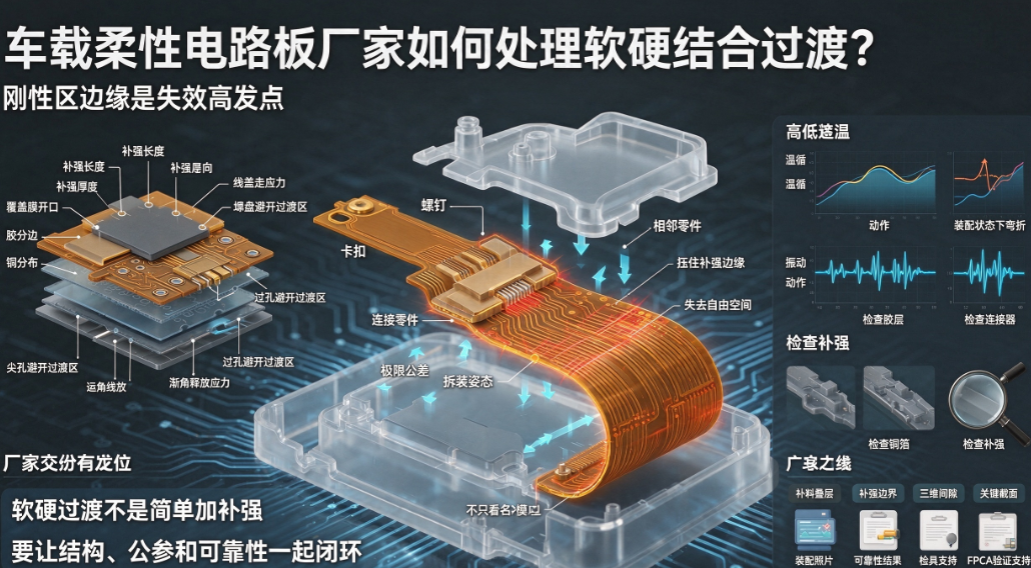
Automotive FPCs commonly feature rigid-flex structural changes at connectors, components, stiffeners, and bend zones. Poor transition design can lead to trace stress, coverlay cracking, and assembly interference. This article analyzes engineering controls for rigid-flex transitions.
Why rigid-flex transitions are prone to failure
Connector ends, component areas, stiffeners, and free-bend zones exhibit differing stiffness. If the boundary terminates abruptly, bending and assembly stresses concentrate along a narrow line. Coverlay, adhesive layers, and copper foil also undergo differential deformation at this location.
Transition design requires coordinated adjustment across multiple layers
Stiffener length, thickness, adhesive edge, coverlay opening, trace routing, and copper distribution must be mutually optimized. Vias, pads, sharp corners, and neck-down sections must not fall within primary transition zones. Stress relief via fillets and tapered trace widths is recommended where necessary.
Housing tolerances exacerbate edge-related issues
Snap-fits, screws, connectors, and adjacent parts pressing against stiffener edges can eliminate the designed clearance for the FPC post-assembly. 3D reviews must assess worst-case tolerances, disassembly/reassembly sequences, and motion envelopes—not just nominal models.
Validation must occur after thermal and mechanical cycling
High and low temperatures alter adhesive and material dimensions; motion and vibration repeatedly load the edge. Bend testing, thermal cycling, and vibration testing should be conducted in the assembled state, followed by inspection of coverlay, copper foil, adhesive layers, stiffeners, and connectors.
Manufacturers must deliver transition-zone evidence
Evidence includes material stack-up, stiffener boundary definition, 3D clearance analysis, critical cross-sections, assembly photos, and reliability test results. Hongyi Precision provides rigid-flex transition design, stiffener engineering, fixture validation, and FPCA verification support for automotive FPCs.