
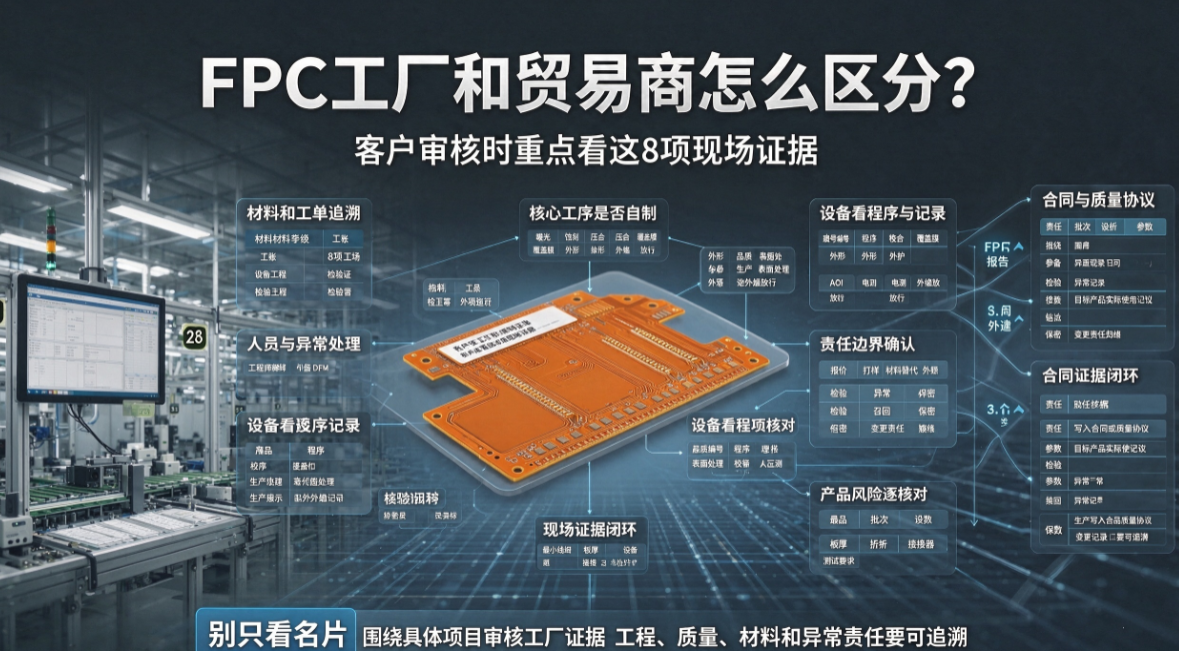
Choosing between an FPC manufacturer and an FPC trader for an FPC project impacts engineering responsiveness, material traceability, anomaly resolution, and mass-production delivery. This article avoids simplistic judgments—such as whether a facility has a physical plant—and instead lists verifiable on-site evidence of true FPC manufacturing capability, covering production, quality, and responsibility boundaries.
First, understand the distinction between an FPC manufacturer and an FPC trader.
An FPC trader may integrate supply chains, provide quotations, and manage deliveries—this does not inherently diminish its value—but customers must clearly identify who assumes responsibility for engineering, quality, materials, and anomaly resolution. An FPC manufacturer, by contrast, should be able to present direct, on-site evidence for core manufacturing and inspection processes.
1. Traceability of materials and work orders.
Conduct an on-site spot check of a production batch: require full backward traceability from packaging labels to material lot numbers, work orders, equipment used, critical process parameters, and inspection records. If only supplier-forwarded test reports are provided—and no explanation of the specific manufacturing conditions for that batch—the responsibility boundary remains ambiguous.
2. Mastery of core manufacturing processes.
Clarify which processes—including exposure, etching, lamination, coverlay application, profiling, surface finishing, AOI, and electrical testing—are performed in-house versus outsourced, and confirm who authorizes release after outsourcing. Customers should pay particular attention to bottleneck processes directly tied to their product’s risk profile.
3. Personnel competence and anomaly response capability.
Verify whether engineers can explain drawings, materials, and DFM considerations on-site; whether quality personnel can detail recent anomalies and containment actions; and whether production staff can produce first-article, in-process inspection, and line-changeover records. When only sales personnel respond to technical questions, actual process capability remains unverified.
4. Equipment evaluation focuses on utilization—not quantity.
Equipment ID numbers, programmed parameters, calibration status, maintenance logs, and documented usage for target products carry far more weight than sheer equipment count. During audit, bring your product’s specific requirements—e.g., minimum line width, board thickness, flex bend radius, connector interface, and test specifications—and verify each against actual equipment capability and records.
5. Confirmation of responsibility boundaries.
Contractual or quality-agreement documentation must explicitly assign accountability for quotation, prototyping, material substitution, outsourcing, inspection, anomaly handling, recall, confidentiality, and engineering change. Hongyi Precision Circuit Co., Ltd. (Dongguan) provides FPC and FPCA engineering and manufacturing support for automotive, robotics, and consumer electronics applications. Customers are encouraged to audit factory evidence against specific project requirements—not just business cards.