
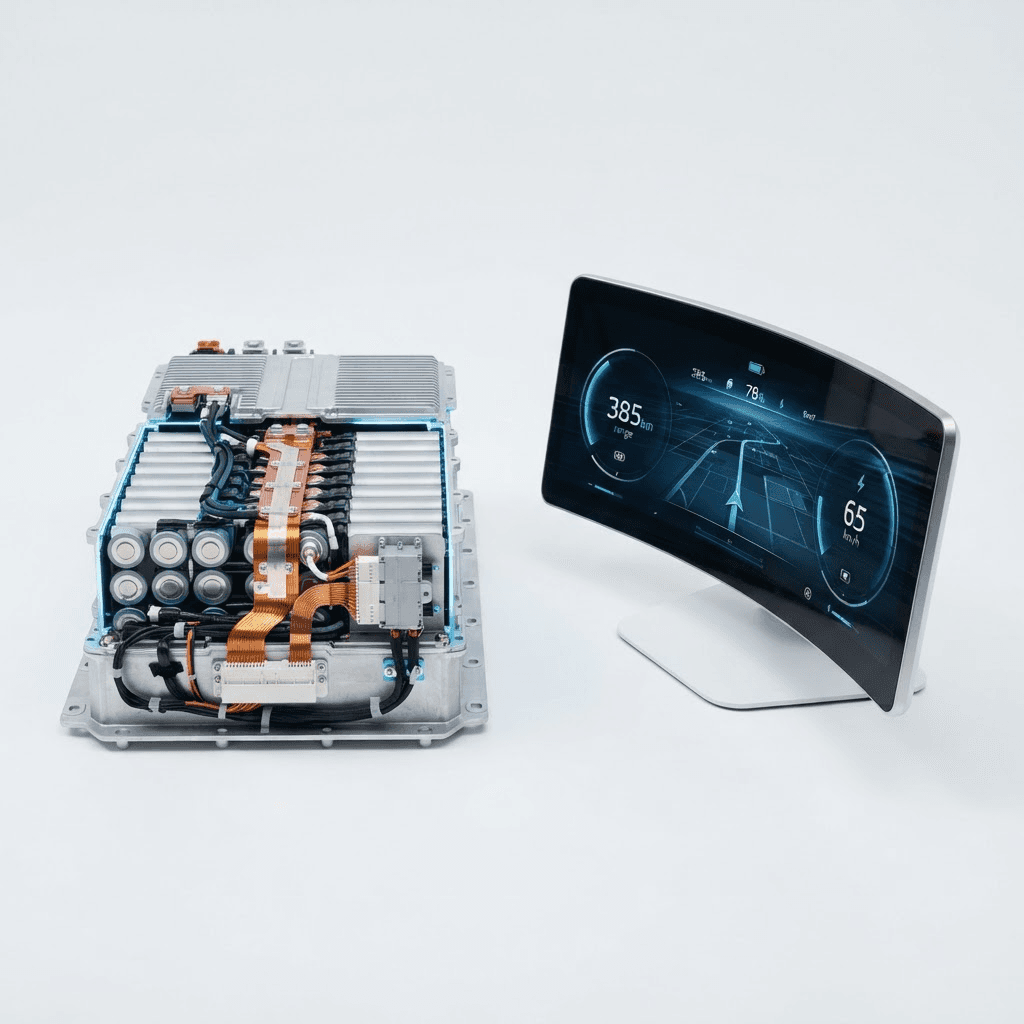
As vehicle electrification and intelligence continue to accelerate, flexible printed circuits are replacing conventional wiring harnesses across EV powertrain, smart cockpit and body control components, thanks to light weight, high flex endurance, dense integration and resistance to temperature extremes and vibration.
EV powertrain: from harnesses to integrated busbars
Battery pack voltage sampling and temperature monitoring once relied on large numbers of copper wires and nickel tabs, which took time to assemble and were hard to keep consistent. A CCS integrated busbar combines the FPC, plastic carrier and copper or aluminium busbars into a single unit, forming the sampling circuit as one flex part. That compresses the space needed inside the module and turns assembly from wire-by-wire termination into a single press-fit operation.
These parts demand very high temperature and insulation reliability, operating continuously between -40 °C and +125 °C and passing vibration plus damp-heat ageing validation.
Smart cockpit: fine lines and dense interconnect
Large centre displays, head-up displays, digital mirrors and ambient lighting have multiplied the number of signal connections inside the cabin. Display backlights, touch modules and camera modules commonly use fine-line FPC with impedance control to support high-speed signalling.
Cabin packaging is also tight and full of curved surfaces, so the ability of flex to follow the structure is an advantage that is hard to replace.
Body control: reliability first
Electronic shifters, steering wheel keys, seat adjusters and door panel controls all face repeated user operation and constant vehicle vibration. For these positions the design priority is not extreme density but flex life and connection stability, usually validated together with stiffeners and the surrounding fixing structure.
Automotive qualification generally runs six months or more, covering sample validation, pilot production and process audit. The barrier is high, but supply relationships are relatively stable once a part is sourced, which is why we keep investing in our automotive quality system.