
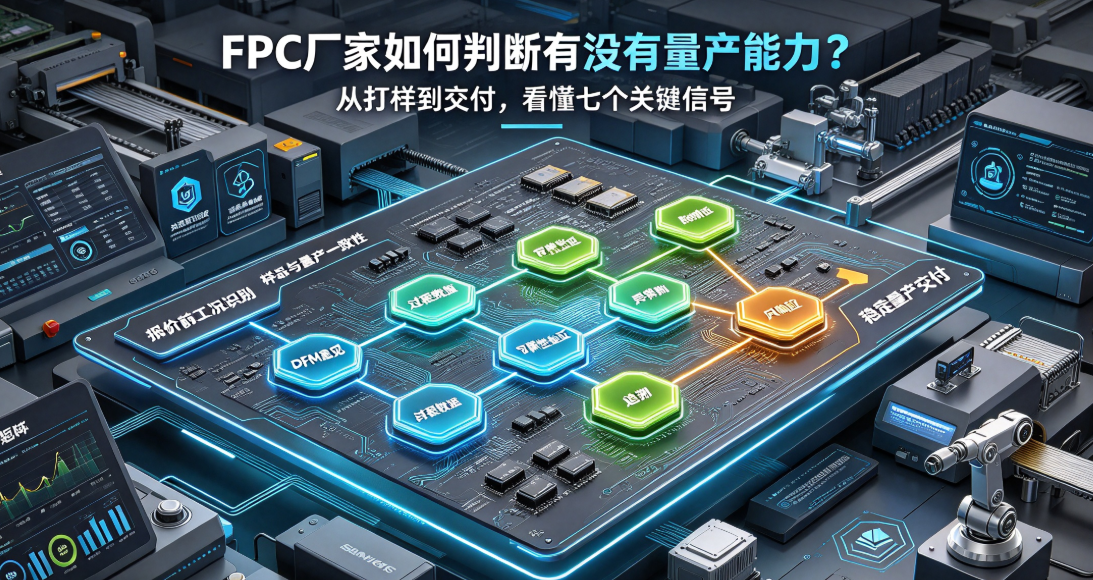
A website portfolio and a good prototype show only part of an FPC manufacturer’s capability. Stable delivery depends on engineering review, process windows, yield data, traceability, and corrective action. This article presents seven practical signals for evaluating true mass-production readiness.
Being able to build a prototype does not guarantee stable mass production
When customers evaluate an FPC manufacturer, a visually perfect prototype can be persuasive. Yet prototype builds may use hand-selected materials, slower takt time, and on-site engineering adjustment. Mass production introduces material-lot variation, equipment takt, inspection cost, and delivery pressure. Evaluation should therefore cover the complete delivery chain rather than one sample.
Signal 1: The supplier asks about the application before quoting
An experienced manufacturer asks about bend motion, temperature, assembly datum, signal type, annual volume, lead time, and test requirements. These factors determine material, stack-up, stiffener, routing, and process windows. Specific early questions show that engineering—not only sales—is involved.
Signal 2: DFM comments are specific and executable
Useful DFM identifies locations and parameters: a via in the bend center, a stiffener interfering with a clip, a connector root needing a rounded transition, or a trace specification outside the practical yield window. A simple “manufacturable” statement does not reduce project risk.
Signal 3: Prototype and production conditions are aligned
Confirm whether materials, imaging, etching, lamination, outline processing, AOI, and electrical testing used for prototypes will remain in production. If prototypes are made on a laboratory line, request a transfer-validation and first-article plan.
Signal 4: The manufacturer can provide process evidence
Capacity is more than monthly output. Review key-process yield, scrap causes, lot traceability, and corrective-action closure time. Automotive, robotics, and large-format FPC projects require particular control of lamination, fine traces, bend areas, stiffener bonding, and outline dimensions.
Signal 5: Reliability testing matches the application
Dynamic FPC requires bend and vibration tests; automotive FPC requires thermal cycling, humidity, and assembled-state validation; high-speed FPC needs impedance and signal-integrity checks. Continuity testing alone cannot cover these risks.
Signals 6 and 7: Traceability and corrective response
When a problem occurs, a mature supplier can quickly trace material lots, process parameters, inspection records, and the affected scope. The customer should also know who owns the analysis, when containment will be provided, and how permanent corrective action will be verified. Hongyi Precision supports automotive, humanoid-robot, and consumer FPC from drawing review and prototyping through FPCA and production delivery. These seven signals are best included in the supplier scorecard from the quotation stage.