
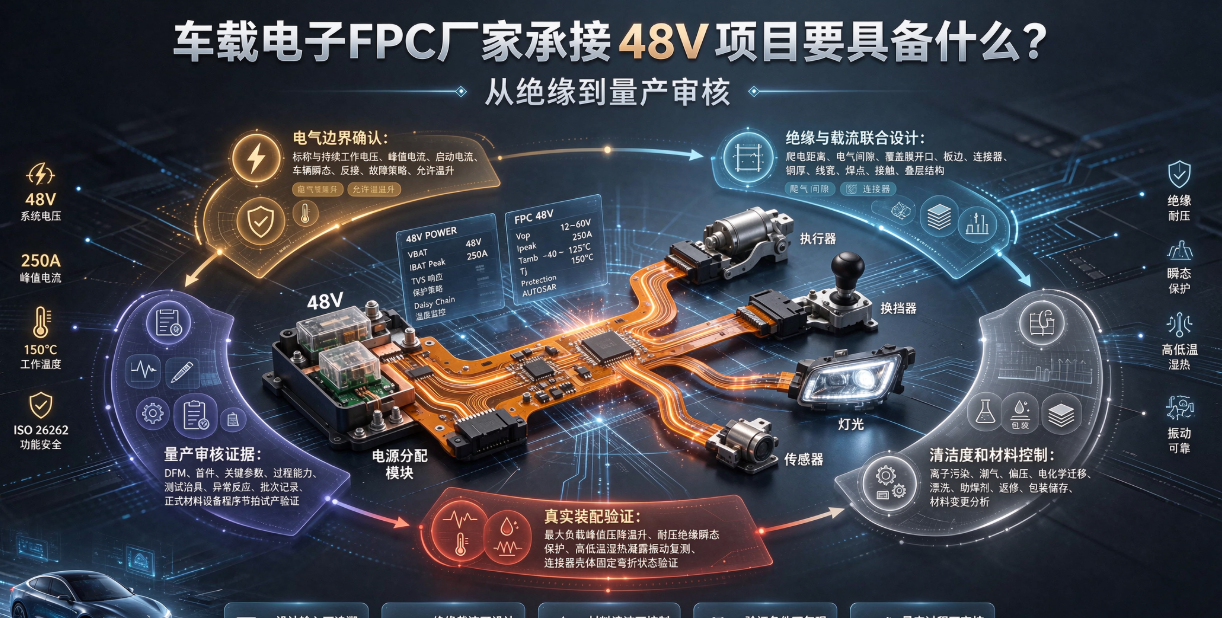
48V automotive FPCs involve more than simply widening traces from low-voltage designs—they require integrated consideration of transients, insulation, temperature rise, connectors, cleanliness, and fault isolation. This article outlines critical capabilities from a supplier audit perspective.
48V systems improve efficiency for automotive actuators and power distribution—but also make FPCs more sensitive to voltage transients, insulation integrity, temperature rise, and contamination. When auditing automotive electronic FPC suppliers, customers must go beyond confirming prior experience with automotive boards and verify whether the supplier can translate 48V network risks into specific material, trace, process, and validation requirements.
Ability to understand project electrical boundaries
The manufacturer should proactively confirm nominal and continuous operating voltage, peak current, inrush current, vehicle transients, reverse polarity, fault-handling strategies, and allowable temperature rise. Without these inputs—relying solely on ‘48V’ and trace width estimation—reliable insulation and current-carrying design is not possible.
Ability to co-design insulation and current-carrying capability
Creepage distance, clearance, coverlay openings, board edge geometry, and connectors collectively define insulation performance; copper thickness, trace width, vias, solder joints, and contact resistance jointly determine voltage drop and temperature rise. Increasing copper thickness also impacts lamination, etching, and flexing—requiring the manufacturer to provide complete stack-up and structural recommendations.
Control of cleanliness and materials
Ionic contamination, moisture, and bias may cause leakage current and electrochemical migration. Audits may review chemical process rinsing, SMT flux selection, manual rework procedures, packaging/storage conditions, and ionic residue control. Material substitutions, adhesive systems, and coverlay changes must undergo impact analysis.
Validation under near-real assembly conditions
Voltage drop and temperature rise under maximum load and peak operating conditions;
Dielectric withstand, insulation resistance, transient response, and protection functionality;
Re-testing after thermal cycling, damp heat, condensation, and vibration;
Validation with connectors, housings, mounting fixtures, and in bent states;
Traceability of abnormal samples, material batches, and test conditions.
Evidence required for mass production audit
Request demonstration of DFM documentation, first-article inspection, critical parameter records, process capability data, test fixture qualification, nonconformance response logs, and batch records. Producing a few prototype samples in the lab does not equate to readiness for mass production—approved materials, equipment, procedures, and takt time must all be validated during trial production.
Hongyi Precision provides FPC and FPCA solutions for automotive electronics applications including shifters, lighting systems, and actuators. We conduct engineering reviews aligned with the electrical, mechanical, and environmental boundaries of 48V projects. When selecting an automotive electronic FPC supplier, customers should prioritize verification of a complete evidence chain—from design input through to production traceability.