
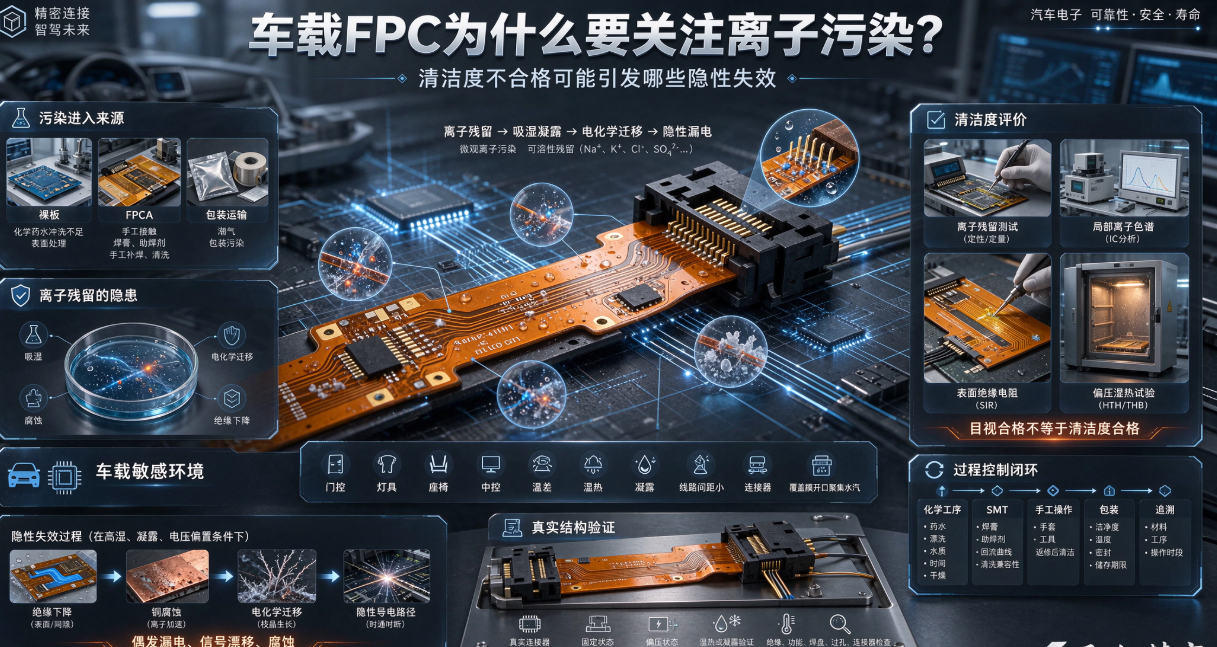
A visually clean automotive FPC does not guarantee acceptable ionic residue. Flux, process chemicals, perspiration, and cleaning residues may cause leakage, corrosion, and electrochemical migration under humid, high-temperature, and biased-voltage conditions. This article outlines control and verification methods.
After completion, an automotive flexible printed circuit (FPC) may appear free of visible contaminants—but this does not confirm compliance with cleanliness standards. Residual soluble ions may originate from etching and surface-treatment chemicals, flux, cleaning agents, human perspiration, and packaging materials. Under high humidity, condensation, and applied voltage bias, such residues can degrade insulation resistance, corrode copper traces, and induce electrochemical migration.
Sources of ionic contamination
At the bare-board stage, contamination may arise from insufficient chemical rinse, surface treatment, or manual handling; at the FPCA stage, it may stem from solder paste, flux, manual rework, or inadequate cleaning; packaging and transportation may introduce moisture and particulate contamination. After extended storage, contamination risks often remain undetectable via routine visual inspection.
Why automotive environments are more sensitive
Control modules, lighting systems, seat controls, and infotainment units frequently experience thermal cycling, high humidity, and condensation. With fine-pitch FPC traces and moisture-prone openings at connectors and coverlay edges, ionic residue combined with voltage bias can gradually form conductive paths—manifesting as intermittent leakage, signal drift, or localized corrosion.
How cleanliness is evaluated
Evaluation methods must align with customer specifications, board area, and application environment—and may include ionic residue testing (e.g., ROSE), localized ion chromatography, surface insulation resistance (SIR), or biased humidity testing. Each method addresses distinct failure mechanisms; visual inspection after standard cleaning cannot substitute for quantitative verification.
Process control is more effective than final inspection
Chemical processes require strict control of chemistry concentration, rinse duration, water purity, dwell time, and drying parameters;
SMT processes must manage solder paste selection, flux type, reflow profile, and post-reflow cleaning compatibility;
Manual operations mandate specified gloves, tools, and documented cleaning procedures following rework;
Packaging must control internal cleanliness, relative humidity, seal integrity, and shelf-life limits;
Nonconforming batches must be fully traceable to material lot, process step, and operator shift.
Verification must reflect real-world assembly
If the FPC is installed in a sealed or semi-sealed enclosure, humidity or condensation testing should be performed with actual connectors, mechanical fixation, and operational bias applied—and results assessed for insulation resistance, functional performance, pad integrity, via reliability, and connector interface. Testing bare boards alone may overlook contamination introduced by assembly materials or post-assembly cleaning.
Hongyi Precision controls FPC and FPCA cleanliness per automotive-grade material specifications, manufacturing processes, and customer requirements. During customer audits of automotive flexible circuit board suppliers, reviewers may request documentation of cleaning procedures, ionic residue or insulation resistance data, and protocols for traceability, quarantine, and disposition of nonconforming lots.