
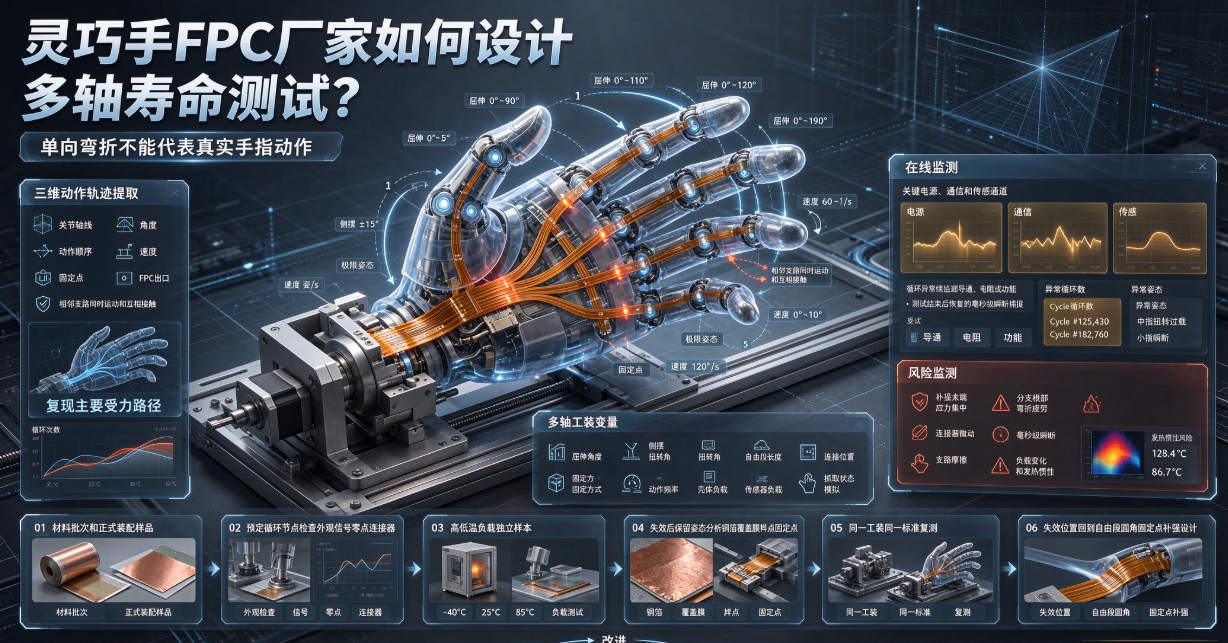
Dexterous hand finger motion involves flexion/extension, lateral sway, torsion, and dynamic load changes. Conventional unidirectional bending tests often overestimate FPC lifetime. This article outlines multi-axis fixturing, in-line monitoring, sample strategy, and failure analysis methods.
Dexterous hand FPC motion is not simply back-and-forth bending between two planes. During finger flexion/extension, lateral sway, torsion, branch-to-branch friction, and load variation may occur simultaneously. A fixed-radius unidirectional bending tester may yield high cycle counts but fails to reflect actual lifetime once installed in the finger.
Extract test trajectories from 3D motion data first.
Record each joint axis, angle, motion sequence, speed, extreme posture, anchor point, and FPC exit location. For multi-finger FPCs, also consider whether adjacent branches move concurrently and contact each other. The test fixture must replicate the primary load path—not merely the minimum bend radius.
Which variables must the multi-axis fixture control?
Flexion/extension angle, lateral sway, torsion angle, free-length segment, connector position, and fixation method must all be repeatable. Actuation frequency must not induce thermal or inertial effects inconsistent with real product use. When load is applied, simulate the influence of housing, sensors, and grasping states on the FPC.
In-line monitoring is more critical than pre- and post-test electrical testing.
Micro-cracks and connector micro-movement may cause millisecond-level intermittent opens—recovering after testing ends. Critical power, communication, and sensing channels must be continuously monitored for continuity, resistance, or functional integrity throughout cycling; record cycle count and posture at each anomaly.
How to schedule samples and staged inspections:
Use representative samples from different material batches and full-assembly configurations;
Inspect appearance, signal integrity, zero-point stability, and connectors at predetermined cycle intervals;
Assign independent samples for high/low temperature or loaded conditions to avoid variable confounding;
Preserve the FPC’s posture upon failure and analyze copper foil, coverlay, solder joints, and fixation points;
Re-test improvement solutions using the same fixture and pass/fail criteria.
How test results feed back into design:
If failures concentrate at stiffener ends, branch roots, or connectors, adjust free-length segments, corner radii, fixation points, or stiffeners; if failures occur randomly across multiple locations, investigate material consistency, lamination quality, and process control. Lifetime figures hold engineering value only when linked to a clear failure mechanism.
Hongyi Precision can assist in designing FPC multi-axis dynamic validation plans based on dexterous hand 3D structure, sensing circuit layout, and target lifetime. A professional dexterous hand FPC manufacturer delivers not just samples—but proven reliability of the integrated circuit, material, and assembly under real motion conditions.