
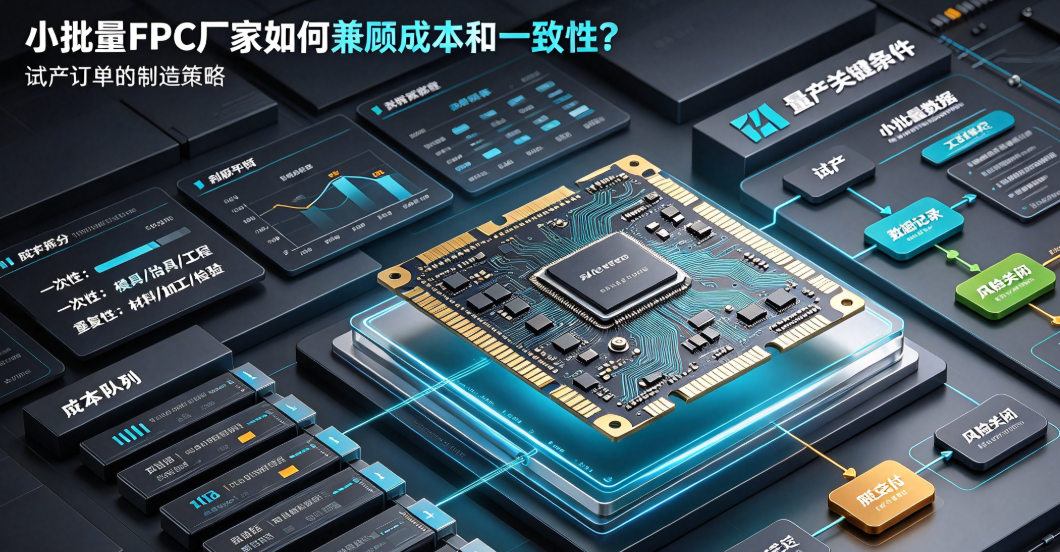
R&D validation, medical instruments, robotics, and new vehicle programs often require dozens to thousands of FPCs. Though low in quantity, these orders demand consistent materials, stable processes, and full traceability. This article explains how low-volume FPC manufacturers like Hongyi Precision control costs—and accumulate data for mass production—through panelization, fixtures, inspection, and change management.
Low volume does not mean 'simple or minimal'.
Dozens to thousands of FPCs typically fall within R&D validation, customer sampling, or trial production ramp-up phases. While quantities are modest, products may feature fine-pitch traces, irregular outlines, dynamic bending zones, and multiple stiffeners. Material cutting, equipment changeovers, tooling/fixtures, and inspection cannot scale linearly with volume—so per-unit cost is often higher than in mass production.
First, separate costs into one-time and recurring components.
Molds, test fixtures, stencils, and engineering reviews represent one-time investments; materials, processing, inspection, and packaging scale with quantity. When evaluating low-volume FPC suppliers, customers should request itemized quotations to identify which costs will not recur during follow-up orders or mass production.
Panelization optimization is not simply about maximizing fill rate.
Higher material utilization lowers cost—but FPCs also require attention to copper grain direction, bend performance, outline machining, and handling clearance. Over-compressing board spacing may cause punching deformation or laser thermal impact; rotated panel layouts may misalign dynamic bend directions with material anisotropy. Effective panelization balances material efficiency with process stability.
Trial production must retain key conditions intended for mass production.
- Use the same approved materials and primary production equipment specified in the mass-production plan.
- Maintain critical parameters for lamination, exposure, etching, stiffener application, and outline routing.
- Implement first-article verification, AOI inspection, electrical testing, and critical-dimension measurement records.
- Clearly label any temporary manual operations—and define automated or semi-automated alternatives prior to mass production launch.
How low-volume data supports subsequent mass production.
Each batch should document actual yield, dominant defect types, material waste, labor hours, and delivery exceptions. Engineering teams use this data to refine design tolerances, panelization schemes, fixture designs, and inspection standards. If low-volume runs prioritize only on-time delivery without capturing structured data, mass production will still require extensive re-validation.
What makes a manufacturer suitable for long-term collaboration.
An ideal low-volume FPC partner delivers both rapid response and seamless scalability into volume production. Customers should confirm lead times for repeat orders, material stocking policies, revision control, change isolation protocols, and mass-production transfer procedures. Hongyi Precision supports continuous delivery—from samples and low-volume batches to full-scale production—with a focus on closing specific risks in each trial run, rather than repeating identical sample builds.