
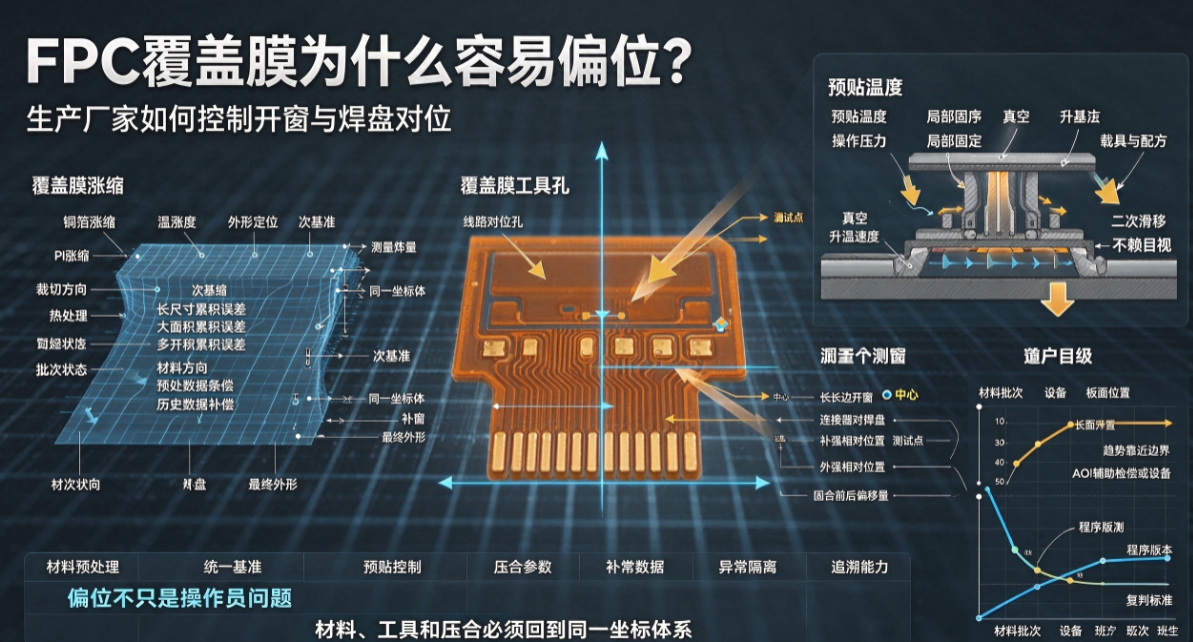
Coverlay misalignment may obscure pads, reduce insulation margins, or intrude into dynamic bend areas. This article explains registration control in FPC manufacturing—from material expansion/contraction, tooling datum consistency, pre-lamination, lamination, and first-article measurement.
FPC coverlay protects circuitry and provides electrical insulation, but windows must precisely expose pads, gold fingers, and test points. Misalignment may obscure pads, reduce solderable area, expose copper, or allow coverlay edges to encroach into dynamic bend zones. Coverlay registration results from combined effects of material behavior, tooling design, and lamination process.
Materials inherently expand and contract
Coverlay, polyimide (PI), and copper foil exhibit varying degrees of expansion/contraction under humidity, temperature, cutting direction, and thermal treatment. Longer dimensions, larger panel sizes, and multi-window designs increase cumulative error risk. Prior to production, material grain direction, batch status, and pre-conditioning parameters must be verified—and historical compensation data applied where appropriate.
Tooling datums must remain consistent across all process steps
Using disparate datums—for coverlay tooling holes, circuit alignment holes, and outline tooling—causes tolerance stack-up. Engineering review must define primary and secondary datums plus measurement methodology, ensuring coverlay windows, pads, stiffeners, and final outline reference the same coordinate system.
Pre-lamination and lamination may induce slippage
Pre-lamination temperature, pressure, handling sequence, and localized fixturing affect coverlay placement. During lamination, adhesive flow, vacuum level, pressure profile, and ramp rate may cause secondary slippage. Large-format or irregular-shaped FPCs require dedicated fixtures and optimized adhesive formulations—not reliance on operator visual alignment.
Which locations require first-article measurement?
Four corners, center, and representative long-edge windows;
Connector-end pads, fine-pitch pads, and test points;
Coverlay edge proximity to dynamic bend zones;
Relative positions of stiffeners, outline, and mounting holes;
Coverlay-to-pad offset before and after lamination.
Production control requires trend analysis—not just pass/fail judgment
Registration data should be statistically tracked by material batch, equipment ID, shift, and board zone. If offsets trend toward specification limits, proactive compensation or equipment adjustment is required—rather than waiting for pad coverage defects to trigger rework. AOI can assist in window-to-pad inspection, but program version control and re-evaluation criteria must be formally validated.
Hongyi Precision controls FPC window registration through material pre-conditioning, unified datums, coverlay pre-lamination, optimized lamination parameters, and first-article inspection. When evaluating FPC manufacturers, customers may assess whether they maintain compensation data across varied panel sizes and materials—and how misalignment anomalies are isolated and traced.