
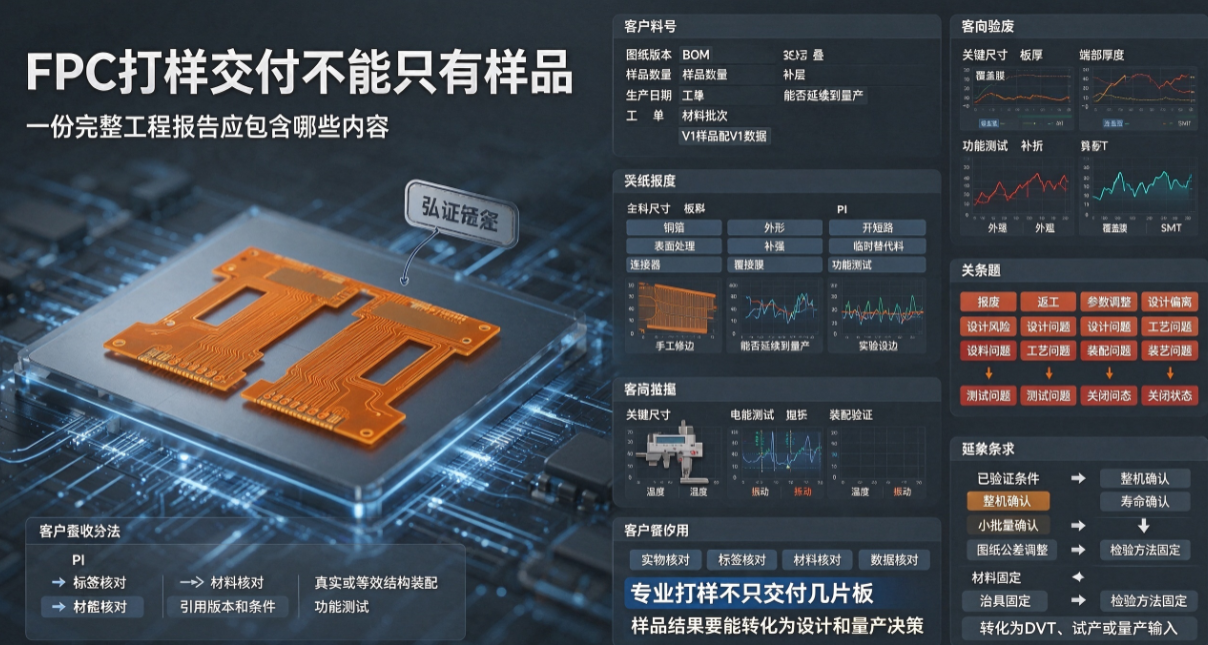
An FPC sample that lights up or conducts only confirms basic functionality. To ensure prototyping results inform the next revision and mass production, suppliers must also deliver engineering data—including material specs, dimensional measurements, electrical test results, process details, anomalies, and actionable recommendations.
After receiving FPC samples, customers commonly receive only the physical parts and a shipping document. If assembly or reliability issues arise later, it becomes difficult to determine whether the root cause lies in design, materials, or process. Professional FPC prototyping delivers not just a few boards—but a complete set of engineering information reusable in subsequent design iterations and mass production.
Section One: Sample Identification
The report must include customer part number, drawing revision, BOM, stack-up, sample quantity, production date, work order, and material lot numbers. When multiple revisions run in parallel, each sample and its corresponding report must be clearly labeled—e.g., V1 samples must not be paired with V2 data.
Section Two: Material and Process Status
List key materials including PI, copper foil, coverlay, stiffener, surface finish, and connectors. Any temporary substitute materials, experimental equipment, manual edge trimming, or selective sorting must be explicitly stated—and assessed for feasibility in mass production.
Section Three: Measurement and Test Data
Critical dimensions, board thickness, end thickness, and outline geometry;
Continuity/short-circuit, insulation resistance, impedance, or functional testing;
Coverlay alignment, stiffener placement, pad integrity, and visual inspection;
SMT, connector, and assembly verification results;
Agreed-upon mechanical and environmental tests—including flex cycling, thermal cycling, and vibration;
Section Four: Anomalies and Deviations
All scrap, rework, parameter adjustments, and design deviations occurring during sample fabrication must be recorded transparently. Delivering only final-pass samples hides mass-production risks from the customer. Issues must be categorized by root cause—design, material, process, assembly, or test—and include closure status.
Section Five: Next-Step Recommendations
The report must specify which conditions have been validated, which require full-system integration, lifetime validation, or pilot-run confirmation; which drawing tolerances need adjustment; and which materials, fixtures, and inspection methods are recommended for standardization. Only then can sample results become actionable inputs for DVT, pilot production, or mass production.
How Customers Should Use This Report During Acceptance
Cross-verify physical samples, labels, materials, and data point-by-point. Conduct assembly and functional testing in actual or equivalent structural environments. When issues arise, reference the report’s version and test conditions directly—reducing time spent reconfirming documentation between parties.
Hongyi Precision provides tailored engineering prototyping reports for FPC projects—including material specifications, first-article data, dimensional measurements, electrical test results, assembly verification, and reliability assessments. When selecting an FPC prototyping supplier, ask not only about lead time—but also what decision-ready data the samples will carry.