
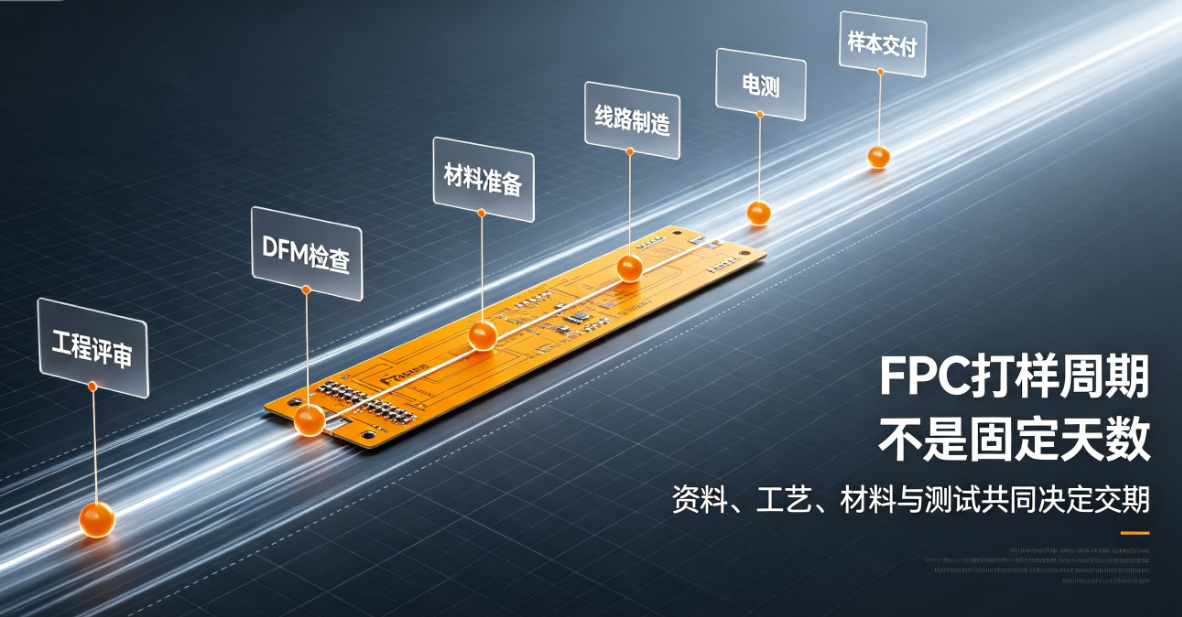
There is no universal lead time for FPC prototyping. Actual delivery depends on data completeness, trace complexity, outline geometry, material availability, and whether assembly or reliability testing is included. Faster engineering data confirmation enables smoother production scheduling.
FPC prototyping lead time depends on project complexity
There is no universal lead time for FPC prototyping. Data completeness, trace and outline complexity, material readiness, and inclusion of assembly or reliability testing all affect actual delivery. The faster engineering data is confirmed, the smoother subsequent production scheduling becomes.
What typical steps are involved in FPC prototyping?
- Data receipt and engineering review: Confirm Gerber files, stack-up, materials, dimensional tolerances, connectors, and application operating conditions.
- DFM review and issue resolution: Verify trace width/spacing, hole placement, bend areas, stiffener placement, and panelization design; propose modifications if necessary.
- Material and tooling preparation: Prepare base materials, coverlay, stiffeners, and molds or laser parameters based on material system, quantity, and outline process requirements.
- Circuit fabrication and surface finishing: Complete exposure, etching, drilling, lamination, and surface treatment processes.
- Outline processing and electrical testing: Perform punching or laser cutting, followed by continuity, short-circuit, and visual inspection.
- Sample verification and delivery: Deliver per agreed packaging, labeling, and inspection records; include dimensional and test reports when required.
How should prototyping time be broken down?
Stage Key Output Common Delay Causes Engineering Review DFM issue list, material & stack-up confirmation Missing files, version mismatches, undefined operating conditions Engineering Preparation Production data, panelization, tooling, and materials Special material lead time, unconfirmed connectors or stiffeners Sample Manufacturing Traces, lamination, surface finish, and outline processing High-density traces, special tolerances, or rework Inspection & Validation Electrical test, dimensional check, visual inspection, and agreed tests Impedance or reliability testing requiring dedicated fixtures Packaging & Delivery Reports, labels, packaging, and logistics info Unclear customer packaging specs or partial shipment requirementsAfter procurement receives an estimated timeline (e.g., 'X days'), they should clarify the start point. Timing typically begins upon technical issue closure, data freeze, and order condition confirmation—not from the initial RFQ email. If the project includes assembly, fixtures, or third-party testing, confirm explicitly whether those items are included in the quoted timeline.
What situations commonly delay delivery?
Missing stack-up or material specifications, undefined bend areas, last-minute connector model changes, repeated stiffener position adjustments, or ad-hoc test additions trigger re-review or rework. Procurement and R&D teams are advised to provide all such information upfront when issuing RFQs.
Another common issue is 'concurrent revision.' For example, if a sample has already entered outline processing and the project team then changes connector location or minimum bend radius, the supplier may need to regenerate production data—and previously processed work-in-progress may no longer be usable. For urgent projects, establish a clear data freeze point and designate a single point of contact to release official versions.
If parallel execution is truly necessary, document associated risks: prepare generic materials using interim versions, then proceed to irreversible processes only after critical dimensions are confirmed. This can shorten some waiting periods but must not bypass DFM validation or confirmation of critical parameters.
How to accelerate prototyping?
Use a standardized data package including layout files, mechanical drawings, BOM, operating conditions, quantity, target date, and acceptance criteria. For dynamic flex or automotive applications, also specify bend radius, cycle count, temperature, vibration, and assembly constraints—avoid discovering post-delivery that operating conditions are mismatched.
Project teams can also maintain a lead-time tracking sheet recording: current file version, pending issues, responsible party, required response date, planned start date, and expected delivery date. For cross-departmental approvals, this proves more effective than repeatedly asking 'Where are we now?'
What comes after sample delivery?
Upon receipt, verify labels, revision, quantity, and inspection records before proceeding to assembly and functional validation. When issues arise, retain defective samples, mounting method, photos, test conditions, and failure timestamps—avoid vague descriptions like 'does not work.' Comprehensive feedback helps FPC suppliers determine whether anomalies stem from design, manufacturing, soldering, or system-level assembly.
First-round sample approval does not automatically authorize mass production. If material, trace, stiffener, or assembly changes occur, confirm whether revalidation is required—and maintain traceability between each sample batch and its corresponding drawing revision.
Frequently asked questions
Does complete data guarantee on-time delivery?Complete data reduces back-and-forth during review, but actual lead time still depends on material availability, process capability, production capacity, and test scope.
Can we fabricate samples first and add operating conditions later?Not recommended. Missing operating conditions may result in unsuitable structural design and increase costs for second-round prototyping.
Can DFM be skipped for expedited prototyping?Not recommended. Communication and scheduling wait times can be compressed, but critical checks for traces, materials, bending, and assembly risks remain essential.
When delivery is delayed, what should be checked first?First verify data freeze timing, open issues, special material status, and newly added test items—then assess responsibility and mitigation options.
This article was compiled by Hongyi Precision based on common touchpoints observed during FPC prototyping communications. Actual lead times depend on engineering data review, material confirmation, and mutually agreed production schedules; design guidelines refer to IPC-2223, while finished product requirements align with IPC-6013 and customer-specific acceptance criteria.