
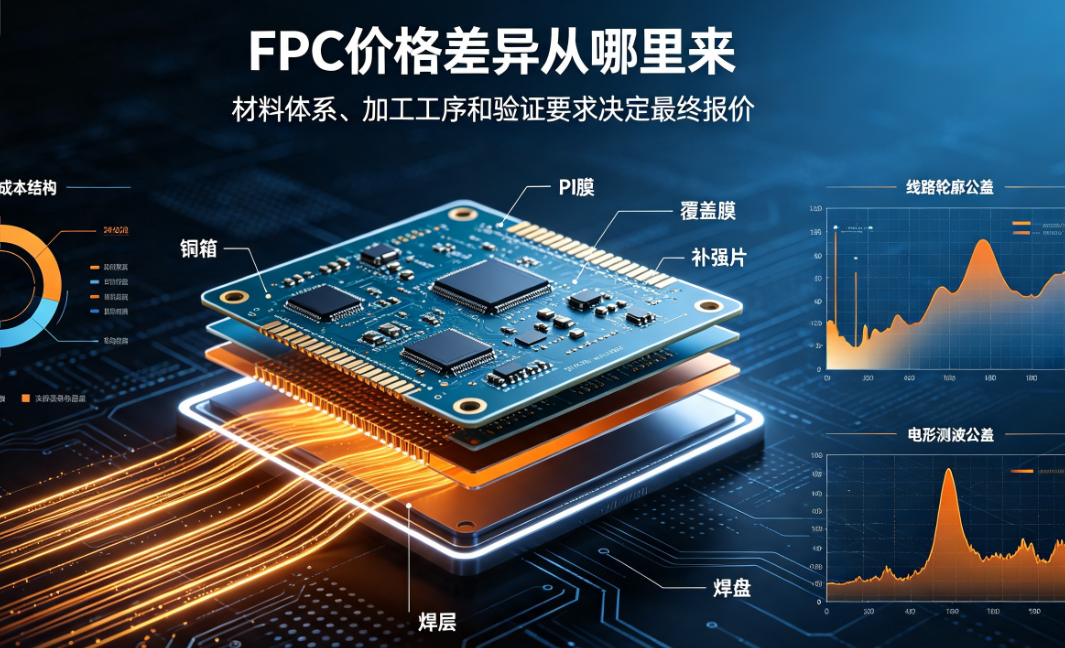
FPC pricing is jointly determined by material selection, circuit complexity, manufacturing processes, test requirements, and order quantity. Even FPCs of identical dimensions can vary significantly in final cost due to differences in layer count, copper thickness, stiffener configuration, surface finish, or reliability specifications. Therefore, quoting cannot rely solely on outline dimensions—complete design and application documentation should be provided upfront.
FPC pricing is not based solely on area and quantity.
FPC pricing is jointly determined by material selection, circuit complexity, manufacturing processes, test requirements, and order quantity. Even FPCs of identical dimensions can vary significantly in final cost due to differences in layer count, copper thickness, stiffener configuration, surface finish, or reliability specifications. Therefore, quoting cannot rely solely on outline dimensions—complete design and application documentation should be provided upfront.
Key factors affecting FPC pricing
- Layer count and circuit density: Single-sided, double-sided, and multilayer structures involve different materials and processing flows; smaller line widths and spacings increase manufacturing and inspection requirements.
- Copper thickness and material system: Rolled annealed (RA) or electrolytic (ED) copper, base material thickness, coverlay, and adhesive system all influence cost and flexing performance.
- Stiffeners and structural components: PI, FR-4, or stainless steel stiffeners are commonly required at connector and soldering areas; stiffener location and quantity affect process routing.
- Surface finish: Different finishes—including ENIG and HASL—support distinct assembly methods, with corresponding impacts on cost and lead time.
- Outline geometry and process difficulty: Irregular cutouts, high-density via patterns, narrow edge margins, and tight tolerances increase tooling and inspection effort.
- Test requirements: Continuity, hi-pot, impedance, dimensional, or flex-life testing each influence the quoted price range.
- Prototyping and mass production quantities: Prototyping typically includes engineering review and tooling costs; unit pricing for mass production must be calculated based on annual usage volume.
- Delivery and packaging requirements: Staged delivery, special packaging, labeling, and batch traceability should be specified during quotation requests.
Understanding price composition
Cost Category Typical Content Procurement Verification Focus One-time Engineering Fees Engineering review, tooling, test program development, and first-article preparation Whether fees apply only to initial orders and whether they recur upon design changes Material Costs Base material, copper foil, coverlay, stiffeners, adhesives, and surface finish Clarity of brand, model number, thickness, and substitution rules Manufacturing Costs Imaging, etching, drilling, lamination, routing, and cleaning Inclusion of complex circuitry, irregular outlines, and tight tolerance requirements Inspection & Validation Costs Electrical testing, impedance measurement, dimensional verification, cross-section analysis, or reliability testing Which tests are included in the quote and whether reports incur separate charges Delivery Costs Packaging, labeling, staged delivery, and logistics Requirements for vacuum sealing, moisture protection, or customer-specified labelsWhen a quotation lists only a single total price, it is difficult to determine whether suppliers have calculated costs under identical conditions. Buyers may request that suppliers itemize key materials, surface finish, test scope, one-time fees, and mass production tiered quantities—preventing low-bid proposals from losing comparability after essential processes are added later.
A common quotation comparison scenario
Assume two FPC suppliers can both produce the same double-sided prototype: one quotation includes electrical testing, dimensional reporting, and connector-area stiffening; the other covers bare-board fabrication only. Though the quoted amounts may differ substantially, the deliverables are not equivalent. The correct approach is to first establish a unified 'quotation baseline version'—locking drawing revision, materials, quantity, test scope, and packaging conditions—before comparing price, lead time, and technical feedback.
Engineering changes must also be documented separately. For example, modifying silkscreen differs significantly from altering circuit traces, hole locations, or stack-up—each impacting cost and tooling differently. Quotation emails should clearly indicate document revision numbers and change points to prevent suppliers from quoting against outdated data.
Recommended documentation for quotation requests
At minimum, provide Gerber or ODB++ files, stack-up structure, BOM (if assembly is required), quantity, target lead time, operating environment, flexing method, and acceptance criteria. More complete information enables FPC suppliers to issue comparable quotations and reduces subsequent price revisions.
We recommend the quotation package include at least the following:
- Circuit files, outline drawings, and assembly drawings—with clearly marked revision dates;
- Layer count, copper thickness, base material, coverlay, stiffener, and surface finish requirements;
- Prototyping quantity, pilot-run quantity, estimated monthly usage, or annual usage volume;
- Requirements for SMT, connector soldering, functional testing, or reliability validation;
- Static or dynamic flexing method, minimum bend radius, temperature/humidity conditions, and vibration exposure;
- Acceptance requirements for dimensions, electrical performance, appearance, packaging, and traceability.
For projects not yet fully finalized, separate 'must-meet' requirements from those 'open to supplier DFM suggestions.' This allows FPC suppliers to propose manufacturability improvements without altering critical interfaces—rather than issuing an apparently precise quote based on incomplete data.
Frequently asked questions
Can a quotation be generated from just an outline drawing?A preliminary estimate is possible, but accurate assessment of material, circuit, and test costs requires full circuit documentation and operational context. Formal quotation still requires complete layout data and application details.
Why is prototyping pricing higher than mass production unit cost?Prototyping includes fixed costs such as engineering review, tooling, and first-article verification—costs which are amortized across volume in mass production.
Does a lower quotation always represent better value?Not necessarily. Buyers should compare material specifications, lead time, test scope, yield management capability, and lot traceability concurrently.
Why do quotations have limited validity periods?Prices for copper, gold salts, adhesives, and subcontracted processes may fluctuate, and project documentation may be revised. Validity periods define the cost basis and document version applicable to the quoted price.
Can a quotation be requested without confirmed mass production forecasts?Yes—prototyping and small-batch pricing can be obtained initially. However, providing a projected quantity range helps assess tooling, panelization, and future tiered pricing.
This article was compiled by Hongyi Precision based on common inquiries encountered during FPC project quotations. Final quotations shall be subject to project documentation review and sample approval; design and acceptance criteria may be further aligned with IPC-2223, IPC-6013, and customer-specific drawings.