
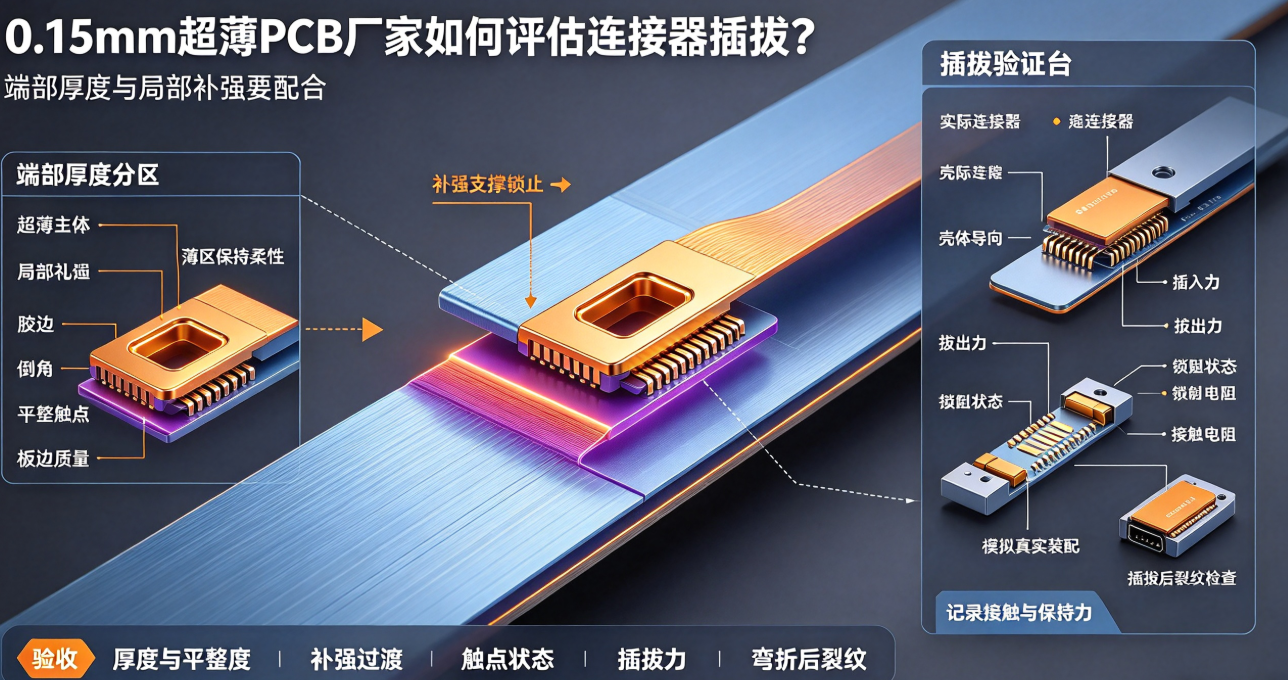
A 0.15 mm ultra-thin PCB is flexible, while its connector end still needs stable thickness, flatness and retention. This article explains how to coordinate end thickness, local stiffening, insertion direction, pads and assembly tolerances.
A 0.15 mm ultra-thin PCB is useful in space-constrained products, but its connector end has strict requirements for thickness and flatness. If the entire board remains equally thin, it may not lock reliably; if the stiffener is too long, it can change bending behavior and assembly clearance. The connector end should therefore be designed as a local structure.
Confirm the connector window first
Check the supported thickness, insertion depth, locking method, contact force, guide geometry, allowable skew and cycle count. Different connectors require different end thickness, chamfer and edge-finish conditions.
Divide the stiffener by function
The stiffener should cover the area required for insertion and positioning, then transition smoothly. Its edge must not fall at the main bend start, while a short stiffener may fail to withstand insertion force. Housing clearance and the FPC exit must be reviewed together.
Contacts and pads are also mechanical features
Connector pads or fingers need consistent flatness, cleanliness and position. Thin boards are vulnerable to edge damage during routing, laser cutting and handling. Inspect end thickness, flatness, contact position and edge quality on finished parts.
Use a fixture that represents real assembly
Manual insertion can create an angle and side load that do not exist in the product. Use the actual connector, housing and guide, then record insertion force, extraction force, lock status and contact resistance. Include repeated service removal when the product is repairable.
Acceptance checklist
End thickness, length, chamfer and flatness
Stiffener location, adhesive edge and stiffness transition
Contacts, pads, board edge and coverlay condition
Insertion, locking, retention and contact resistance
Cracks or damage near the bend zone after cycling
Hongyi Precision can support connector-end thickness zoning, stiffeners, inspection fixtures and insertion validation for 0.15 mm ultra-thin PCBs. The goal is to balance an ultra-thin body with a connector interface that remains reliable in production.