
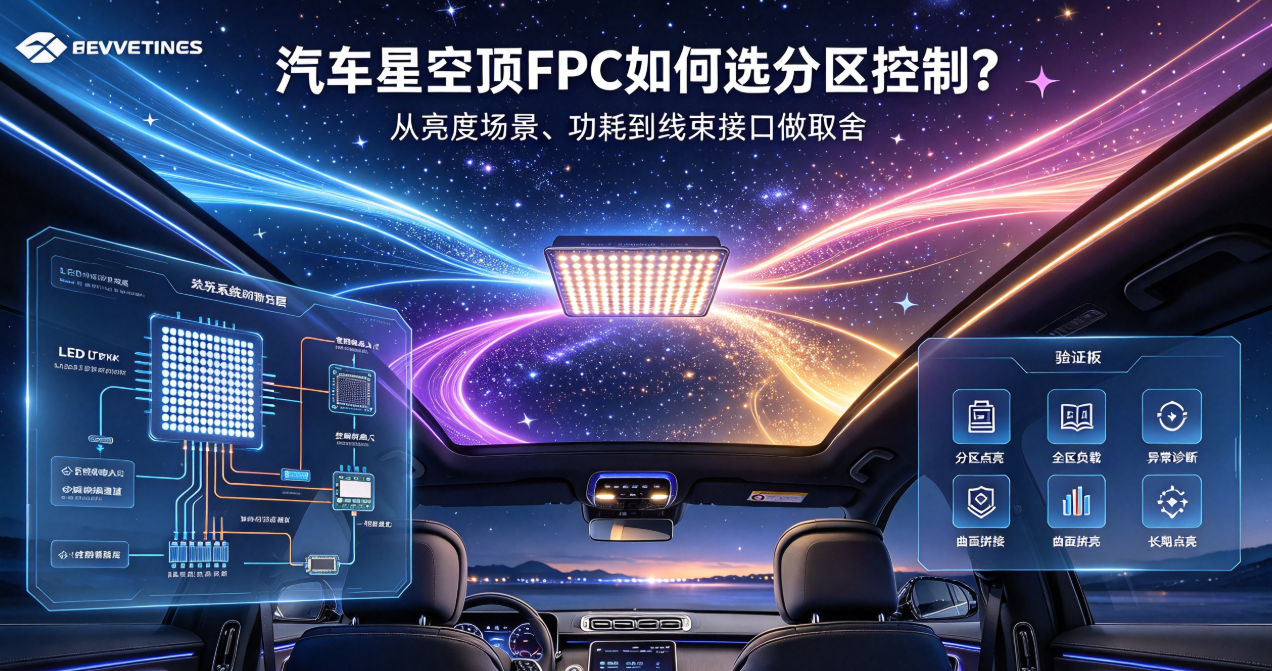
The number of zones in an automotive starry sky roof FPC affects lighting effects, power consumption, wiring complexity, and controller interface requirements. This article explains how to select between integrated, segmented, and multi-zone control—based on application scenarios and manufacturing cost considerations.
Automotive starry sky roof FPCs can be implemented with full-surface uniform illumination, front/rear segmentation, left/right zoning, or multi-zone independent control. More zones enable richer dynamic lighting effects—but also increase demands on power supply, connectors, control channels, firmware, and testing. The optimal zoning scheme must be jointly determined by end-user scenarios and vehicle-level system interfaces.
First, define the desired lighting scenario
If uniform star-point illumination is sufficient, fewer zones with stable power delivery may offer greater value; if dynamic effects such as flowing, breathing, welcome lighting, or inter-zone synchronization are required, additional control channels and data interfaces must be reserved. A high LED count does not necessitate individual control of every LED.
Zoning must consider power consumption and voltage drop
The number of LEDs per zone, trace length, and power entry point affect end-of-line brightness. For large-area roofs, avoid routing all current from a single entry point to the farthest LED. Rational zone-based power distribution and return paths reduce brightness variation and simplify fault isolation.
Zone boundaries must preserve optical continuity
Poorly managed interface locations, seam joints, or diffuser layer overlaps can create visible light/dark boundaries. LED pitch, diffusion distance, control refresh rate, and brightness calibration must all be validated on physical prototypes. Electrical zoning in automotive starry sky roof FPCs ultimately serves visual continuity.
Connector count and serviceability must be balanced
More zones require more connectors, harnesses, and assembly steps. Connectors must feature standardized definitions and fool-proof mechanical design—and service access must be pre-considered. If a zone is designed for independent replacement, module boundaries, datum features, and test points must be defined during design.
How to validate a zoning scheme
Light each zone individually to verify brightness, power draw, and control response;
Illuminate all zones simultaneously to assess voltage drop, thermal rise, and end-of-line brightness;
Simulate open-circuit, short-circuit, and connector faults to confirm diagnostic logic;
Observe light/dark boundaries under actual curved surfaces, diffusers, and headliner panels;
Complete temperature, vibration, seam integrity, and long-duration illumination validation.
Hongyi Precision evaluates zoning, power architecture, and interface solutions for automotive starry sky roof FPCs—based on vehicle platform, controller capability, LED count, and lighting effect requirements. More zones are not inherently more advanced; the right solution balances visual performance, cost, manufacturability, and serviceability.