
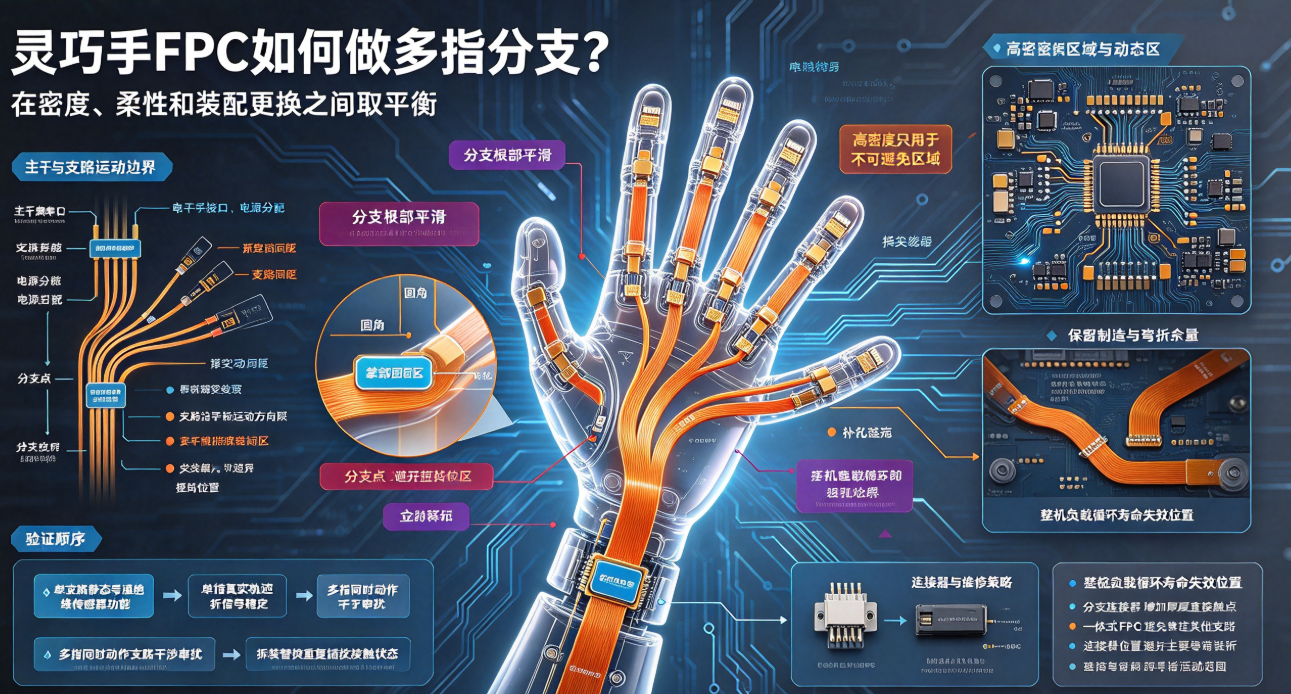
Dexterous hand FPCs typically branch from a single main interface into multiple finger circuits. Branch location, harness length, fixation method, and connector count jointly impact bending cycle life and maintenance efficiency. This article outlines design trade-offs in multi-finger branching architecture.
Dexterous hand FPCs are rarely single-conductor traces; instead, they typically branch from a palm- or wrist-mounted interface into multiple finger circuits connecting tactile, position, and force sensors. While multi-finger branching reduces overall harness count, it introduces challenges including root-level stress concentration, inter-branch friction, complex assembly sequencing, and difficult field replacement.
Trunk and branches are first segmented by motion boundary.
Load conditions differ across the palm mounting zone, finger base buffer zone, and fingertip dynamic zone. The trunk is best suited for centralized interfaces and power distribution, while branches should extend along the natural direction of finger motion. Branch points must avoid locations where multiple branches simultaneously twist.
Branch roots must feature smooth geometry.
Sharp corners, abrupt width changes, clustered vias, and stiffener edges can all cause localized stiffness discontinuities. Adequate spacing between adjacent branches is required to prevent mutual compression during bending. Where necessary, stress relief is achieved using rounded corners, tapered trace widths, and localized coverlay structures.
High-density routing does not mandate uniform minimum trace/space throughout.
While sensor pads at the fingertip demand high density, the trunk and dynamic zones should retain sufficient manufacturing tolerance and bending margin. Extending minimum trace/space all the way to the branch root increases etching variability and fatigue risk. A more robust approach applies high-density structures only where unavoidable.
Connector selection and service strategy must be defined early.
If individual fingers require independent replacement, branched connectors may be used—but they add thickness, mass, and additional contact points. With monolithic FPC designs, repair procedures must ensure no unintended tension is applied to adjacent branches. Connector placement should avoid primary bending zones and active finger motion envelopes.
Validation sequence for multi-finger FPCs:
Single-branch static continuity, insulation resistance, and sensor functionality;
Single-finger dynamic bending along real-world trajectories with signal stability monitoring;
Inter-branch interference and crosstalk during simultaneous multi-finger actuation;
Contact integrity after disassembly, replacement, and repeated mating cycles;
Cyclic lifetime and failure location under full-system operational load.
Hongyi Precision provides integrated design support for dexterous hand FPCs—including trunk layout, finger branch routing, connector integration, and dynamic bend zone optimization—based on 3D mechanical structure and sensor placement. The quality of a dexterous hand FPC is not measured solely by channel density, but by how reliably each branch maintains performance over long-term motion cycles and service interventions.