
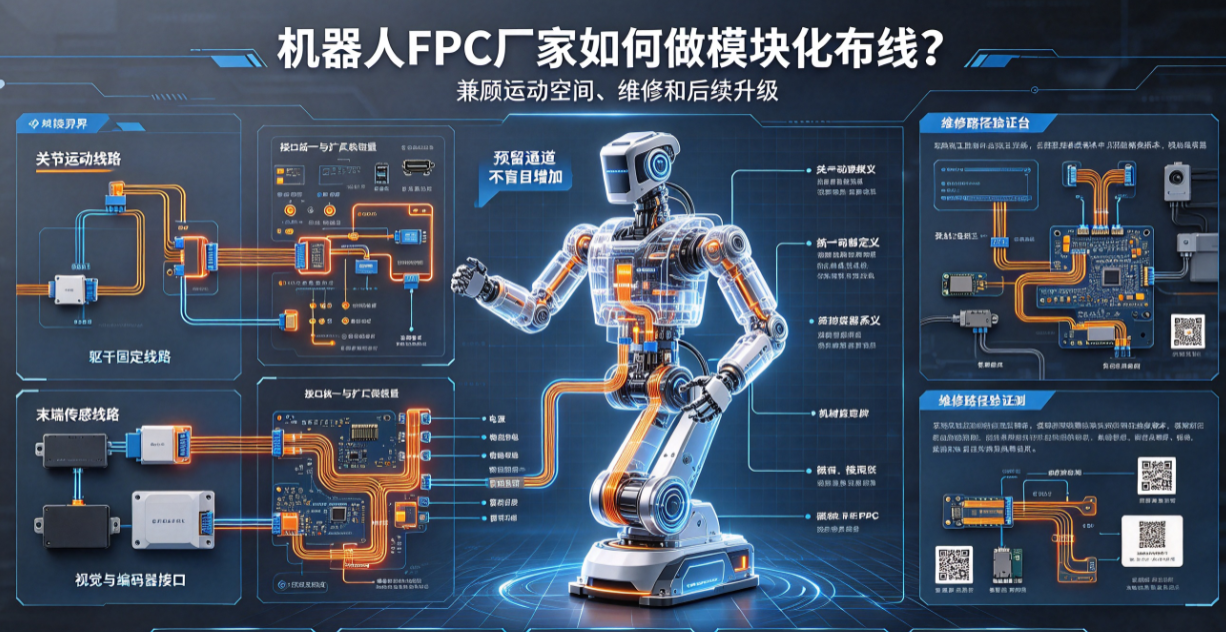
Robot FPCs must not only flex within joints but also support full-system module replacement, commissioning, and upgrades. This article outlines modular FPC design methodology for robots—from module boundaries and standardized interfaces to dynamic zones, service paths, and version scalability.
As robotic products evolve continuously, joints, vision systems, sensors, and end-effectors may require individual upgrades or servicing. If FPCs are designed solely for initial assembly, subsequent replacements often lead to interface incompatibility, altered bend paths, and mixed-version installations. FPC manufacturers like Hongyi Precision can adopt a modular approach—integrating routing, interconnection, and service-path planning from the outset.
Define module boundaries by function and motion first.
A module’s boundary should not be determined solely by mechanical housing partitions; it must also account for which traces move with the joint versus those fixed to the torso or end-effector. Dynamic FPC sections should remain as continuous as possible, with connectors placed at mechanically stable, accessible, and load-controlled locations.
Standardized interfaces must retain expansion headroom.
Power, ground, communication, encoder, and sensor interfaces can minimize version differences through consistent pin definitions, connector families, and mechanical keying. For potential future signal channels, reserve pins and test points early—but avoid indiscriminate addition of traces or connectors, which burdens space and reliability.
A buffer zone is required between dynamic zones and module interfaces.
Connector ends and stiffeners are typically rigid and must not be positioned directly at primary bend initiation points. Incorporate buffer segments, anchoring points, and stress-relief structures to prevent pull forces from transferring to dynamic zones during module installation or removal. The 3D motion envelope must accommodate extreme service postures.
Service paths must be validated during prototype stage.
Field engineers must be able to identify module versions, disconnect connectors, replace FPCs, and complete retesting. If service requires forceful pulling or removal of permanently fastened components, the module boundary is poorly defined. Labels, QR codes, interface coding, and test points must be visible or readily accessible on the actual enclosure.
Quality control for version scalability:
Each module carries a unique part number, drawing, BOM, and interface specification;
Connectors, mounting points, and FPC versions are traceable via labels;
Explicit compatibility checks are enforced when mixing legacy and new modules;
Post-upgrade revalidation covers dynamic performance, signal integrity, and thermal behavior;
Service-replacement FPCs maintain controlled material and process consistency with production units.
Hongyi Precision supports robot FPC development in modular interface definition, 3D routing, dynamic bend analysis, and prototype-level service evaluation. Modularization aims not to increase connector count—but to establish clear, verifiable boundaries that enhance upgrade readiness, field serviceability, and manufacturing consistency.