
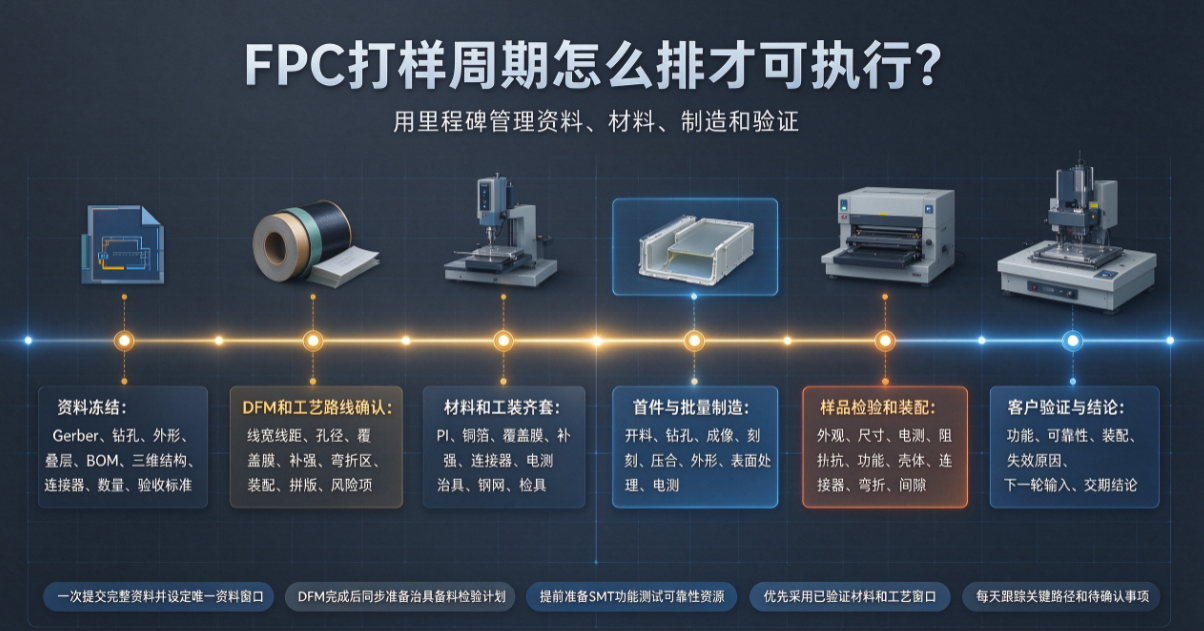
If an FPC prototyping lead time is stated only as a single total number of days, customers cannot identify where delays occur. This article breaks the FPC prototyping cycle into six milestones: documentation freeze, engineering review, material/tooling readiness, manufacturing, inspection, and customer validation.
FPC prototyping schedules are often perceived as 'delayed' because planning typically states only a single total number of days—without clarifying requirements for customer documentation, supplier engineering, materials, fixtures, manufacturing, or validation. Breaking the timeline into defined milestones enables both parties to promptly identify the true bottleneck.
Milestone One: Documentation Freeze
The official start date begins only after full confirmation of Gerber files, drill data, outline, stack-up, BOM, 3D mechanical structure, connectors, quantity, and acceptance criteria. If documentation version conflicts arise, timing resets to the confirmation node—not to the original promised date while drawings remain under revision.
Milestone Two: DFM and Process Route Confirmation
The supplier reviews line width/spacing, hole size, coverlay, stiffener, flex zones, assembly, and panelization—and issues risk items, recommended modifications, and test methods. For complex projects, concurrent structural, material, and electrical reviews may be scheduled, but a final freeze window must be designated.
Milestone Three: Material and Tooling Readiness
Status verification covers PI, copper foil, coverlay, stiffener, connectors, electrical test fixtures, stencils, and inspection gauges. In-stock materials may shorten procurement time—but if they differ from mass-production specifications, the customer must explicitly confirm whether they are approved solely for design validation or also acceptable for subsequent production.
Milestone Four: First-Article and Batch Manufacturing
Processes—including cutting, drilling, imaging, etching, lamination, routing, surface finish, and electrical testing—are executed per the defined process route. First-article approval is a quality gate; it cannot be estimated simply by summing equipment run times. Projects with large dimensions, fine-pitch traces, or special surface finishes require buffer time between process steps.
Milestone Five: Sample Inspection and Assembly
Before sample delivery, visual, dimensional, electrical, impedance, or functional testing must be completed. Upon receipt, samples must be installed into actual or equivalent housings to verify connector mating, bending behavior, clearance, and motion. Bare-board delivery dates do not substitute for FPCA or full-system prototype timelines.
Milestone Six: Customer Validation and Conclusion
Customers should pre-schedule functional, reliability, and assembly validation windows. When test issues arise, root causes must be clearly attributed to drawing errors, material selection, process execution, or assembly—along with defined inputs and delivery dates for the next sample iteration. Otherwise, samples arrive while the project remains stalled awaiting resolution discussions.
Correct Ways to Shorten Cycle Time
Submit complete documentation once—and establish a single, firm documentation freeze window;
Simultaneously prepare fixtures, stock materials, and inspection plans immediately after DFM completion;
Pre-arrange SMT, functional test, and reliability resources;
Prioritize proven materials and validated process windows;
Track only critical-path items and pending approvals daily—do not mask wait-time with misleading total-day figures.
Hongyi Precision provides node-based FPC prototyping schedules tailored to project complexity. Clear milestones help customers understand when their input is required—and enable FPC suppliers to communicate realistic lead times and quality accountability.