
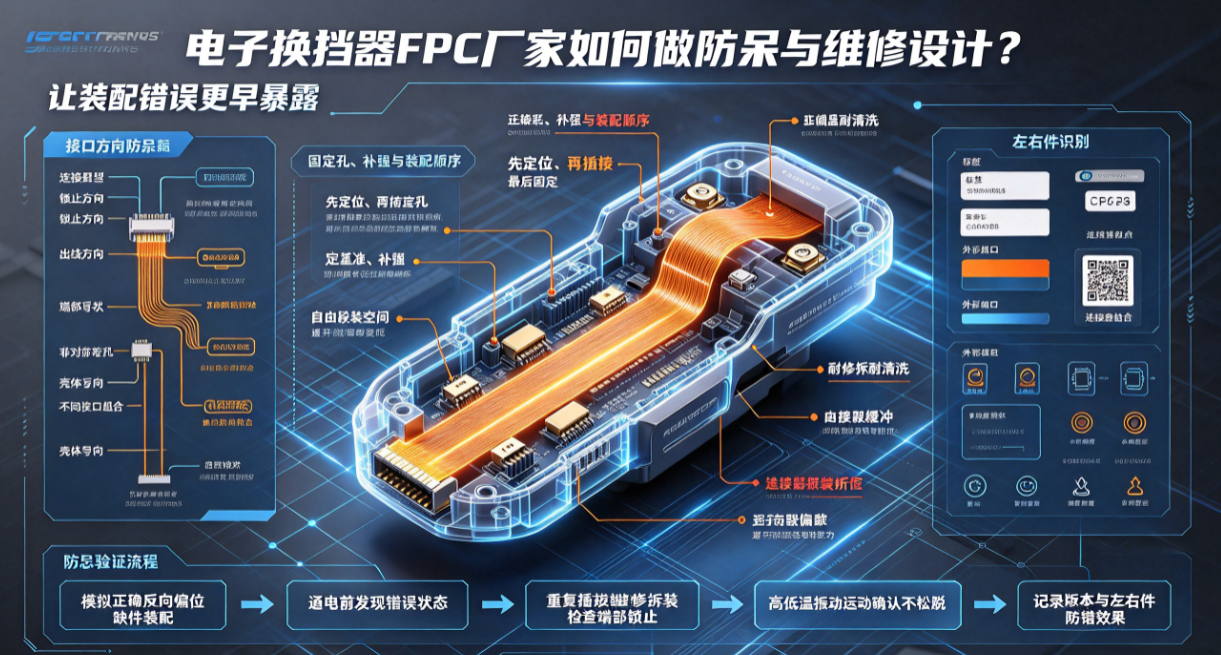
Beyond meeting circuit and flex reliability requirements, FPCs for electronic shifters must accommodate manual and automated assembly, field service disassembly/reassembly, and multi-version management. This article explains mistake-proofing and serviceability design through connector orientation, positioning features, labeling, and test points.
FPCs for electronic shifters are commonly installed in confined housings with multiple connectors and adjacent moving components. If an FPC is inserted backward, misaligned, or forcibly folded, the resulting issue may only surface after full-system power-up. FPC manufacturers—including Hongyi Precision—must integrate mistake-proofing, testability, and serviceability considerations early in the design phase, rather than adding labels reactively after assembly-line errors occur.
Start with connector orientation to prevent reverse insertion
Connector model, latch direction, exit orientation, and end shape should make correct mating the most intuitive path. Where necessary, asymmetric mounting holes, end chamfers, housing guides, or differentiated connector combinations can further reduce reverse-insertion risk. Mistake-proofing features must not compromise insertion/extraction force or end-face flatness.
Mounting holes and stiffeners must align with assembly sequence
If operators must pre-bend the FPC to locate mounting holes, wire strain and connector misloading become likely. Positioning datums, stiffeners, and free-length segments should follow the actual assembly sequence: position first, mate second, secure last—preventing stress concentration at the connector termination.
Version and left/right variants must be instantly distinguishable
The same vehicle platform may require left-hand, right-hand, or configuration-specific shifter FPCs. Labels, color coding, QR codes, profile notches, and connector combinations support rapid on-site identification. Markings must withstand temperature exposure and cleaning agents—and must never reside within dynamic bend zones. Relying solely on paper packaging labels is insufficient.
Serviceability requires accessible test points and disassembly clearance
Technicians need to verify power, ground, communication, and sensor signals without full disassembly. Strategically placed test points, exposed reference features, and readily accessible connectors minimize housing removal and accidental FPC damage. Disassembly paths must be validated to avoid damaging stiffener edges, solder joints, or coverlay during service.
How to validate mistake-proofing design
Simulate correct, reversed, misaligned, and missing-component assembly;
Confirm erroneous conditions are detectable before power-up;
Perform repeated mating/unmating and service disassembly/reassembly to inspect end integrity and latch retention;
Verify no loosening occurs under thermal cycling, vibration, and motion conditions;
Document error-prevention effectiveness across versions and left/right variants.
Hongyi Precision evaluates FPCs for electronic shifters from four perspectives: connector interface, housing integration, dynamic flex behavior, and production-line ergonomics. Truly effective mistake-proofing isn’t a line of documentation—it’s structural, interface- or test-node-based detection that exposes errors as early as possible.