
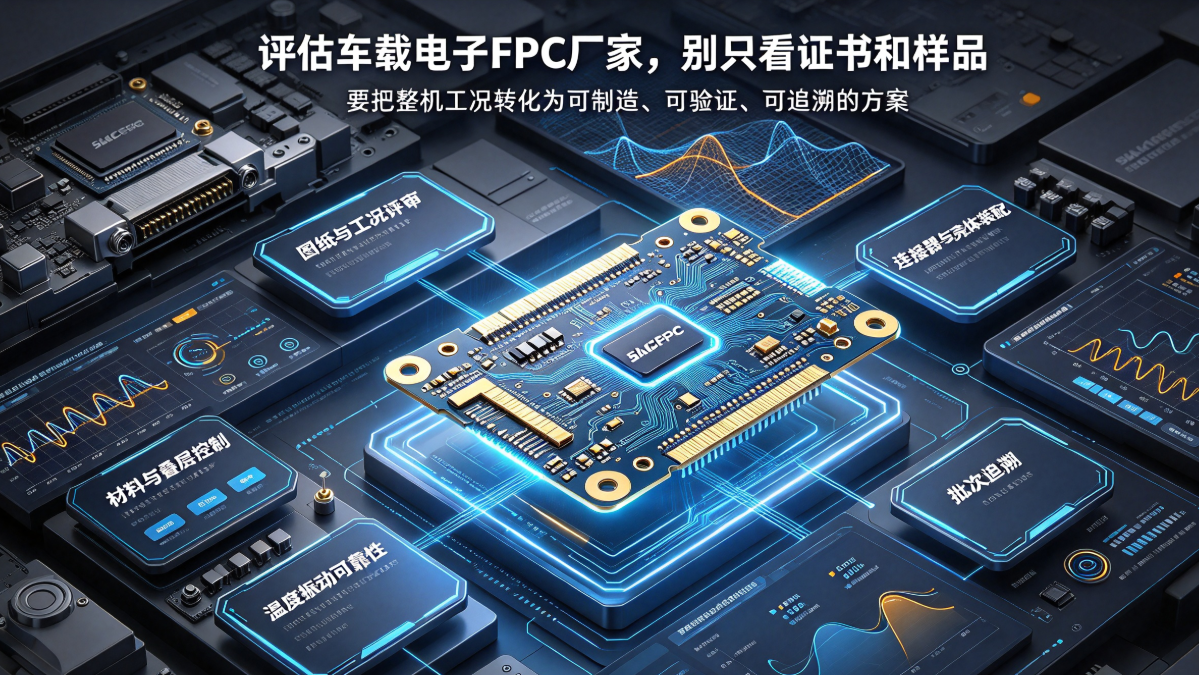
Automotive electronic FPCs must not only conduct electricity but also withstand temperature extremes, vibration, assembly stresses, and batch-to-batch consistency. This article outlines six evaluation criteria—engineering review, materials, interconnects, reliability, process quality, and traceability—for assessing automotive FPC suppliers.
Direct answer:Evaluating an automotive electronic FPC manufacturer requires more than checking for automotive-grade certifications or sample capability. Focus on six capabilities aligned with the specific module: drawing and operating condition review, material and stack-up control, connector and assembly integration, temperature/vibration reliability, in-process inspection, and batch-level traceability.
Automotive electronic FPCs may be used in gear shifters, intelligent cockpits, windshield wipers, switches, position sensors, and other control modules. Bend requirements, temperature ranges, vibration profiles, signal integrity needs, and assembly constraints vary significantly by location—no single set of generic parameters applies across all automotive FPC applications.
1. Confirm real-world operating conditions first
The customer must provide installation location, 3D mechanical structure, connector type, mounting points, actuation path, temperature range, vibration profile, current/signal requirements, and target service life. Without these inputs, the supplier can only make fabrication decisions based on 2D drawings—not perform a true automotive-grade application assessment.
For dynamic flex zones, specify minimum bend radius, bend direction, stroke, cycle frequency, and extreme post-assembly orientation. The clearer the operating conditions, the more technically grounded the material and stiffener recommendations become.
2. Match materials and stack-up to structural lifetime
Polyimide (PI), copper foil, adhesive system, coverlay, and stiffeners collectively influence total thickness, flex stiffness, dimensional stability, solderability, and thermal resistance. Rolled-annealed copper, stiffeners, and coverlay selection cannot be determined independently of trace orientation, bend radius, and mounting method.
Automotive projects also require explicit definitions of material lot control, substitution rules, and change approval processes. Correct material naming alone does not guarantee stable mass production results—the supplier must link materials and stack-up to process parameters and inspection records.
3. Validate connectors and housing assembly together
Failures in automotive electronic FPCs sometimes occur not in the circuit itself, but at the connector interface—due to misalignment, insufficient insertion depth, incomplete locking, end-thickness mismatch, clip deformation, or housing interference. A board passing continuity testing may still exhibit intermittent opens or contact resistance shifts after vehicle integration.
First-article and pilot builds should use actual connectors, housings, fasteners, and harnesses to verify insertion force, lock engagement, clearance, motion envelope, and fit under thermal expansion.
4. Align reliability validation with automotive usage risks
The validation plan must follow project-specific specifications. Common tests include electrical continuity, thermal cycling, vibration, dynamic bending, damp heat, solderability, and functional checks post-assembly. Reports must document sample revision, material lot, tooling, test conditions, sample size, monitoring methodology, and failure criteria.
Passing continuity testing only at room temperature on a flat board does not demonstrate long-term reliability for dynamic automotive FPCs. For gear shifter or switch applications, critical circuits must be monitored during actuation.
5. Ensure process quality enables detection and traceability
Automotive electronic FPC manufacturers must implement process controls at incoming material, circuit patterning, coverlay lamination, stiffener bonding, outline routing, electrical testing, and final shipment stages. When material, dimensional, hole placement, or visual defects are found, affected lots must be quarantined, scope assessed, and disposition documented.
Batch traceability must link drawing revision, material lot, work order, critical process steps, inspection results, rework history, and shipping label data. System certifications (e.g., IATF 16949, ISO 9001) form the management foundation—but cannot substitute for project-specific, real-time evidence.
6. How to compare different automotive electronic FPC manufacturers
Request candidate suppliers to submit DFM analysis, material stack-up proposal, sampling plan, reliability test strategy, inspection reports, and mass production delivery schedule—all based on the same set of drawings, mechanical structure, and acceptance criteria. Evaluation emphasis should not be on which vendor lists the most specs—but on whether their solution aligns with your actual module integration requirements.
Hongyi Precision supports automotive electronic FPC applications including electronic shifters, intelligent cockpits, sensors, and other automotive electronics—with structural review, rapid prototyping, reliability validation, FPCA assembly, and high-volume manufacturing. Specific automotive-grade projects are subject to customer specifications, quality agreements, and mutually approved results.
Summary:The core of evaluating an automotive electronic FPC manufacturer lies in verifying its ability to translate full-system operating conditions into a manufacturable, verifiable, and traceable FPC solution—not merely delivering a functional continuity sample.