
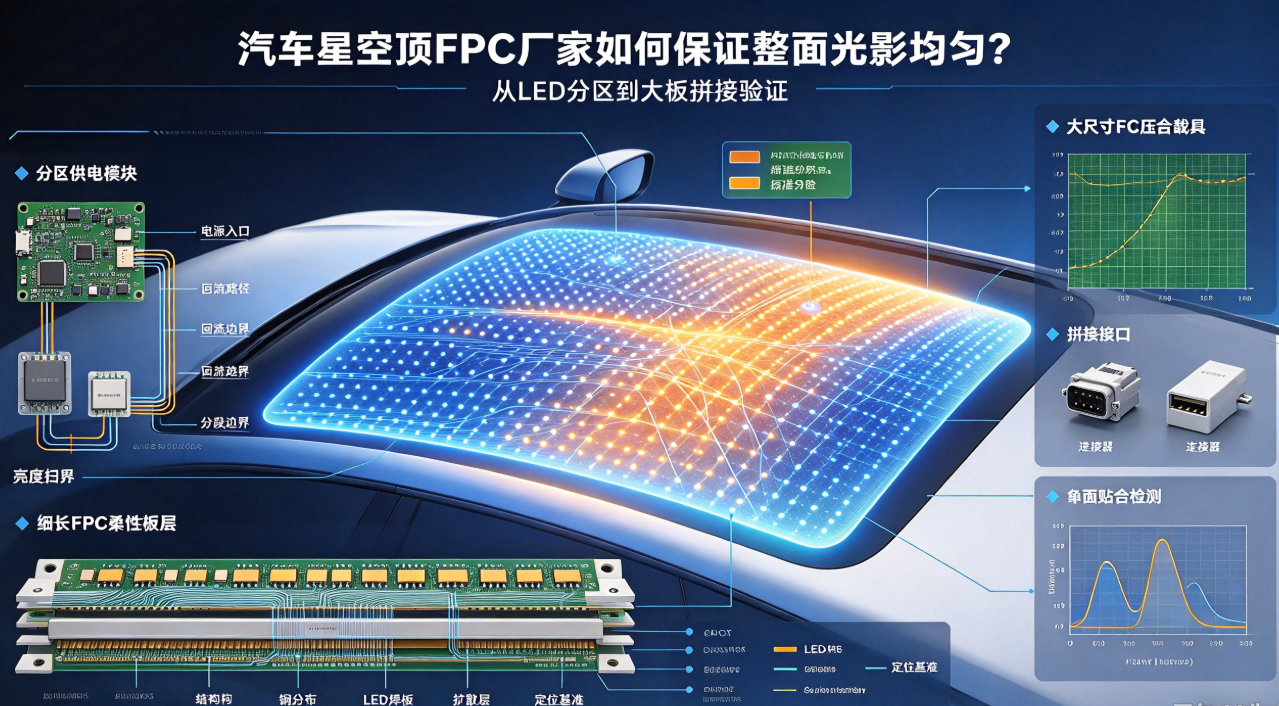
Automotive starry-sky roof FPCs feature large surface areas, densely packed LED positions, curved roof contour conformity, and thermal expansion/contraction tolerance. This article outlines mass-production control priorities—from power zoning, LED placement tolerances, large-panel lamination, splicing transitions, and optical consistency.
While the visual effect of an automotive starry-sky roof appears driven by LEDs and diffuser materials, uniformity is actually influenced by large-area FPC trace layout, power zoning, LED placement accuracy, curved-surface adhesion, and thermal stability. Local dark spots, brightness boundaries, and inconsistent luminance often stem not from individual LED failures—but from misalignment among structural design and manufacturing tolerances.
First, define LED and power zones according to roof area
Roof dimensions, curvature, sunroof opening size, and interior trim occlusion vary across vehicle models. FPC manufacturers—including Hongyi Precision—must define power entry points, return paths, segment boundaries, and connector locations based on LED count, drive current, control architecture, and zoning strategy—to prevent voltage drop-induced brightness variation at panel edges.
Large-area traces also require controlled copper distribution and trace-length uniformity. Simply replicating LED positions without optimizing power zoning may yield acceptable performance on small test panels—but cause edge dimming when installed on full vehicles.
LED placement tolerance must be evaluated jointly with diffuser structure
Cumulative tolerances exist among LED pads, aperture windows, LED packages, diffuser layers, and decorative surfaces. Positional deviation can create localized hotspots or dark zones—especially noticeable at segment splices and curved transitions. Drawings must specify placement datums, zoning reference points, and splicing alignment methods.
Large-panel lamination must prevent warpage and voids
Large-format FPCs—such as 250 × 1550 mm and 500 × 1550 mm—face higher risks of warpage, air entrapment, creasing, and edge deviation during lamination, handling, and profile machining. Material stack-up, vacuum level, pressure, temperature profile, fixture design, and cooling methodology all require dedicated validation for large panels.
Splice locations must ensure both electrical and optical continuity
When multiple FPC segments are joined via connectors or solder joints, mere electrical continuity is insufficient. LED pitch, trace length, diffuser layer overlap, and roof curvature must remain continuous across splices—otherwise a visible brightness boundary will appear. Splice interfaces should also reserve space for assembly and service access, avoiding localized stress after final adhesion.
High/low temperatures and long-term vibration alter illumination patterns
Thermal expansion and contraction may induce relative displacement between the FPC, diffuser layer, and roof trim panel; vibration may compromise LED solder joints, connectors, and mounting structures. Validation must go beyond basic current and continuity testing—brightness and spot distribution across all roof zones must be captured under assembled conditions across temperature and vibration profiles.
Recommended acceptance criteria for automotive starry-sky roof FPCs
Verify dimensional accuracy of LED positions, traces, pads, and splice interfaces;
Test full-surface brightness uniformity using actual curved roof geometry and diffuser layers;
Perform segmented illumination, full-load illumination, and control signal functionality tests;
Complete high-/low-temperature, vibration, flexing, and assembly retention validation;
Document measured brightness values, dark-spot locations, brightness boundary positions, and failure coordinates.
Hongyi Precision offers comprehensive support for large-format automotive starry-sky roof FPCs—including specification selection, drawing review, prototyping, AOI and electrical testing, assembly validation, and volume delivery. When selecting an automotive starry-sky roof FPC supplier, customers should prioritize full-surface illumination consistency and batch-to-batch stability—not merely whether a single board lights up.