
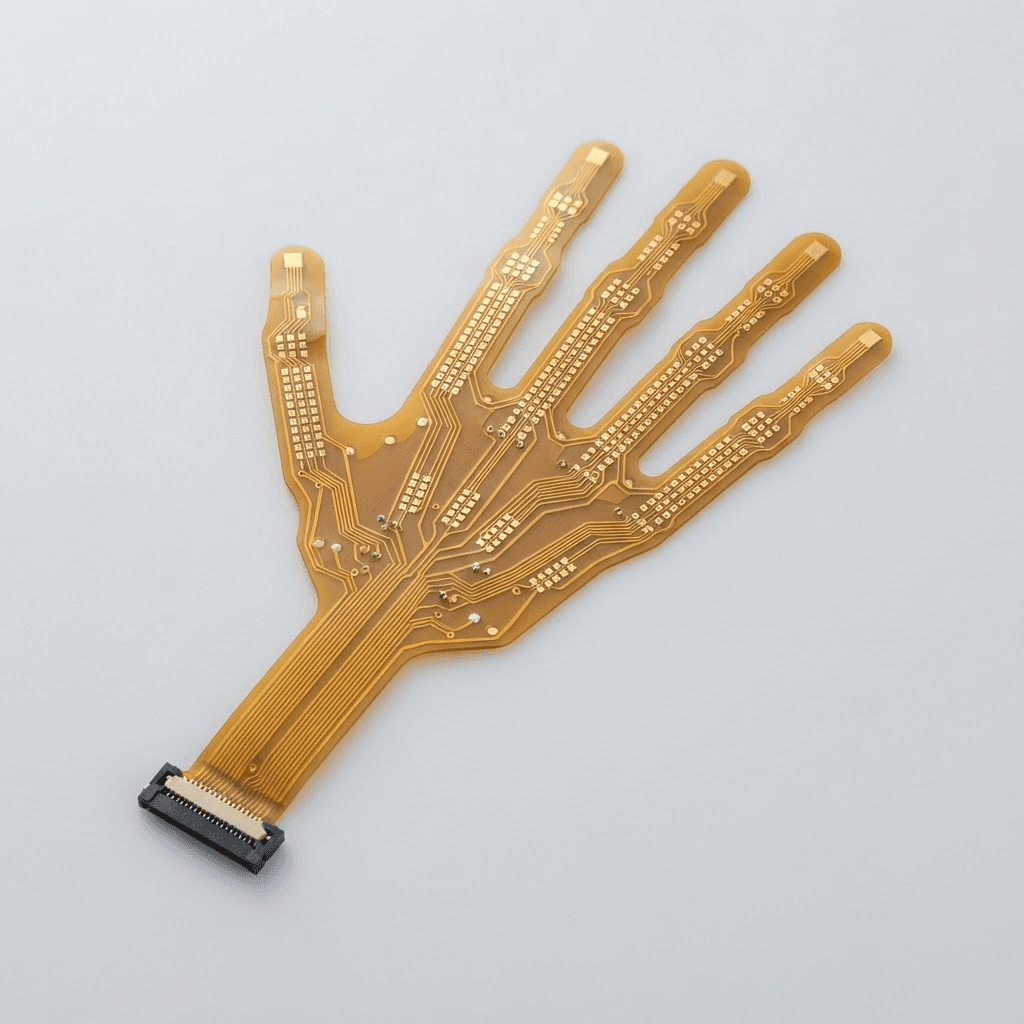
As humanoid robots reach volume production, the five-finger dexterous hand has become a core interaction component, and its internal high-density tactile sensing FPC now determines how the hand feels and how long it lasts. Compared with consumer electronics flex, it faces far tougher constraints on space, bending and consistency.
1. Routing density under tight space constraints
A finger joint has to house the drive mechanism, tactile sensors and all the routing at once, typically leaving only a few millimetres of width for the FPC. On these projects we generally work at 0.035 mm line width and spacing with a 0.05 mm minimum via, using the available cross-section to its limit while locally widening power traces to maintain current capacity.
2. Dynamic flex life
Every grasp means the FPC endures far more reciprocating bend cycles than consumer electronics ever sees. The design has to control minimum bend radius, place conductors on the neutral axis and keep the bend area clean: no vias, no stiffener boundaries crossing it, and traces running perpendicular to the bend axis wherever possible.
3. Consistency of tactile signals
Tactile sensing relies on weak analogue signals, and any noticeable impedance or latency difference between the five fingers will be misread by the control algorithm as a difference in applied force. A shared stack-up, length-matched routing and impedance control within ±10 % keep channel-to-channel variation inside the range the algorithm can safely ignore.
4. Stiffeners and assembly structure
Connector areas and sensor mounting pads need stiffener support, yet the stiffener boundary is exactly where stress concentrates. We keep a sufficient distance between the stiffener edge and the start of the bend, choosing between PI, FR-4, steel and aluminium stiffeners according to how the part is assembled.
5. Design for testability
Once a dexterous hand FPC is installed inside a finger joint it is effectively impossible to rework, so it must be fully screened before shipment. We recommend planning test points during design and pairing them with 100 % electrical testing and AOI, catching problems before assembly rather than during robot commissioning.