
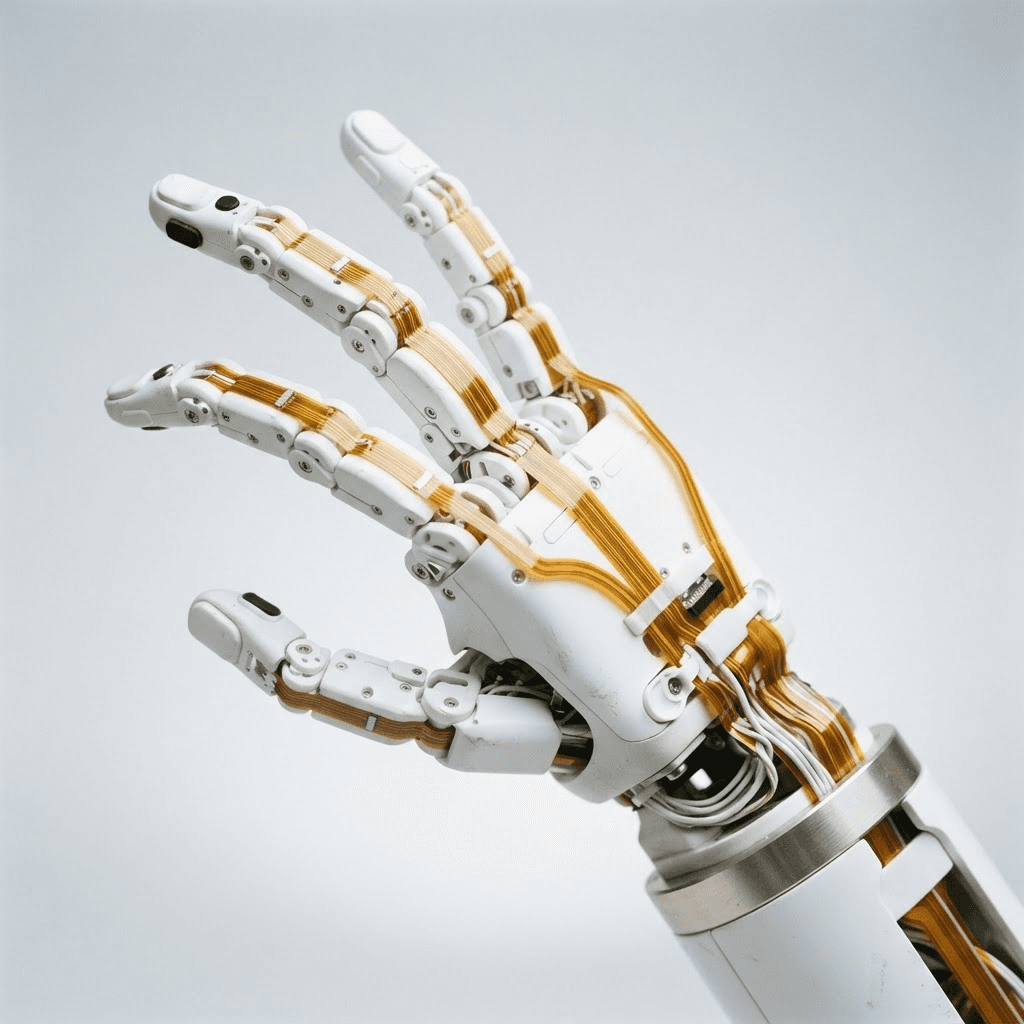
Industrial delivery of humanoid robots has picked up pace recently, driving rapid growth in the market for dedicated high-reliability FPC. A single humanoid robot uses 40-70 flexible circuits across joint drives, tactile dexterous hands and vision modules, raising the bar for dynamic flex life and signal density.
From prototypes to volume production
For the past two years most humanoid robots stayed at the demonstration prototype stage, and flexible circuits were ordered as small prototype batches. Now that robot makers are publishing production schedules, the order profile is shifting from a few dozen samples to rolling monthly volume deliveries, which places entirely different demands on supply chain stability.
For an FPC manufacturer the change shows up in two ways. First, content per unit is high: a single humanoid robot uses 40-70 flexible circuits across joint drives, tactile dexterous hands, vision modules and torso routing. Second, platforms iterate quickly, with the same customer often moving through two or three revisions within six months, so engineering has to turn samples around fast and port processes cleanly between versions.
Dynamic bending is the real barrier
Unlike the static bends common in consumer electronics, robot joints and dexterous hands move back and forth continuously in service. Bend radii are small, frequencies high and travel long, so any compromise in copper ductility or stack-up design eventually surfaces as an open circuit a few hundred thousand cycles in.
For these products we generally use RA rolled copper with a neutral-axis design, placing conductors as close as possible to the neutral plane of bending stress and keeping vias and stiffener boundaries out of the bend area. Combined with adhesiveless coverlay, this reliably delivers flex life beyond one million cycles.
What the supply chain now cares about
Robotics customers buy differently from consumer electronics customers. Because the finished robot is expensive and field repairs costly, batch consistency and problem traceability matter far more than unit price. Complete incoming material records, key process parameters and finished-product test reports are often the deciding factor in a sourcing review.
That is why we manage our robotics line under the same automotive quality system: the process controls and traceability requirements of IATF 16949 transfer directly to volume production of robot FPC, helping customers iterate quickly without giving up reliability.