
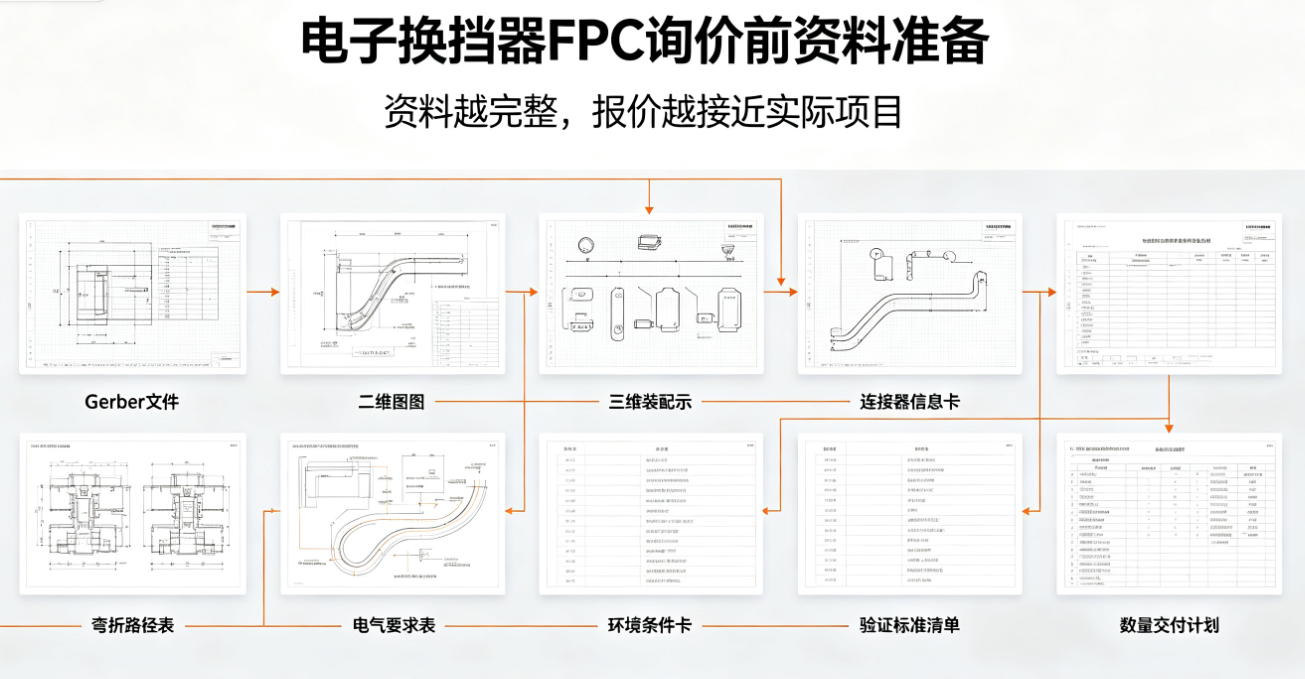
What documentation is required before requesting a quote from an electronic shifter FPC manufacturer? This article outlines key inquiry items—including Gerber files, 3D assembly drawings, dynamic/ static bend conditions, electrical requirements, reliability standards, volume forecasts, and delivery schedules—to help procurement and R&D teams minimize quotation discrepancies.
Direct answer:Before requesting a quote from an electronic shifter FPC manufacturer, prepare at minimum: controlled-version Gerber files; 2D and 3D mechanical documentation; connector specifications; bending and motion conditions; electrical requirements; environmental conditions; validation standards; projected volumes; and delivery schedule. The more complete the documentation, the better the manufacturer can evaluate material selection, process routing, sample lead time, and mass-production cost—resulting in a quotation closely aligned with actual project requirements, rather than an isolated unit price lacking critical assumptions.
FPCs for electronic shifters, column-mounted shifters, and gear position sensors are typically installed in space-constrained automotive assemblies, with certain sections undergoing repeated flexing during mechanism actuation. For electronic shifter FPC manufacturers, quoting involves more than calculating base material and processing costs—it requires assessing manufacturability of the design, feasibility of connector integration and mechanical assembly, and whether special materials or reliability validation are needed. The checklist below serves as a reference for procurement and R&D teams preparing for quotation requests.
I. First, confirm drawing and document version control.
Quotations must be based on a clearly defined product version. Provide Gerber files, netlists or electrical connectivity definitions, drill data, stack-up requirements, outline dimensions, and critical dimensional tolerances—and explicitly indicate version number and date in filenames or the inquiry form.
If 2D drawings and Gerber files are not fully synchronized, specify which elements remain under review during the inquiry. Differences across versions—such as layer count, copper thickness, stiffener application, or connector cutouts—directly impact material consumption, process routing, and final cost.
For applications involving bending and mechanical assembly, providing only a 2D unfolded layout is often insufficient. Supplement with 3D assembly illustrations, housing or bracket boundaries, mounting points, snap-fit locations, and connector positions—enabling the electronic shifter FPC manufacturer to assess the true routing path of traces post-assembly.
II. Clearly separate dynamic bending from static forming.
Specify in the inquiry documentation whether the FPC moves after assembly, and identify which areas undergo dynamic bending versus those requiring only static forming during installation. For dynamic zones, provide bend direction, minimum radius, stroke length, frequency, and target cycle count; for static zones, define forming angle, fixation method, and allowable springback.
Stating only 'bend-resistant' without motion parameters prevents accurate evaluation of rolled-annealed copper, polyimide (PI), coverlay, stiffeners, and trace routing—and hinders realistic estimation of validation effort.
Bend zones should also annotate potential interference points—including housing edges, clips, screws, and connectors. Discrepancies between real-world assembly paths and planar annotations are common root causes of sample rework and quotation revisions.
III. Electrical specifications determine layer count and material selection.
Clarify signal types, power circuit requirements, current-carrying capacity, allowable voltage drop, line resistance, impedance, shielding, and grounding needs prior to quoting. For sensor or communication signals, specify constraints related to crosstalk, noise immunity, or impedance matching.
If only net connectivity is provided—without current, voltage, impedance, or thermal rise requirements—the electronic shifter FPC manufacturer must quote based on assumptions, likely triggering later re-evaluation of copper thickness, trace width/space, and stack-up.
Connector types, pads, gold fingers, or other termination methods must also be specified. Stiffener requirements, surface finishes, and localized thickness at terminations affect both manufacturing cost and assembly/reliability performance.
IV. Environmental and reliability requirements must be stated as executable conditions.
'Automotive-grade' is not a substitute for specific test criteria. Document operating and storage temperature ranges, thermal cycling profiles, vibration severity levels, humidity/chemical exposure requirements, test duration, sample size, and failure criteria.
Common validation scopes for electronic shifter FPC projects include electrical continuity, thermal cycling, vibration, flex durability, damp heat, aging, and mechanical reliability of connectors and solder joints. Whether all tests apply depends on OEM, Tier 1, or mutually approved project specifications.
Test conditions influence material selection, stack-up, stiffener design, and process routing—and also impact sample lead time and validation cost. Including validation scope in the quotation phase helps avoid post-quote changes due to expanded test requirements.
V. Volume forecasts and delivery plans affect unit pricing and production planning.
Provide sample quantity, pilot-run volume, monthly or annual forecasts, and planned ramp-up timeline. Sample, pilot-run, and mass-production volumes differ significantly—impacting raw material procurement, panel utilization, tooling strategy, and inspection methodology.
If the project is still evaluating multiple design options, label each scenario with its estimated volume and corresponding quotation range—rather than treating unconfirmed numbers as firm commitments. This allows the electronic shifter FPC manufacturer to differentiate one-time prototyping fees, tiered mass-production pricing, and potential tooling charges.
Delivery plans should also specify target prototype date, pilot-run milestones, production ramp-up schedule, packaging, labeling, and batch traceability requirements. Expedited timelines may require priority scheduling and accelerated validation—details that must be communicated before quotation.
VI. Items requiring pre-quote confirmation.
The following items commonly trigger price or schedule changes post-quotation—include them explicitly in the inquiry:
Requirement for rolled-annealed copper, specialty PI, specialty coverlay, or localized stiffeners.
Impedance control, shielding, gold fingers, or special surface finishes.
Non-standard outline, branched structures, adhesive backing, protective film, or assembly aids.
SMT assembly, FPCA integration, or pre-installed connectors.
Custom test fixtures, reliability validation, or third-party certification reports.
Customer-specified materials, approved supplier lists, or formal change notification requirements.
Required depth of packaging, labeling, outgoing inspection, and batch traceability.
VII. What to verify in the quotation.
Upon receiving a quotation, do not compare only the tax-inclusive unit price. Confirm whether the quotation explicitly states: product version, layer count and primary materials, surface finish, stiffener details, test scope, tooling fees, sample charges, tiered mass-production pricing, lead time, and quotation validity period.
If the quotation includes phrases such as 'subject to final engineering review' or 'materials pending confirmation', request the manufacturer to list missing documentation and associated impact scope. Transparent assumptions support better project decisions—even if the quoted price appears higher—versus low-cost quotations with ambiguous conditions.
After entering the sample phase, cross-check quotation terms against the final approved drawings, BOM, and validation plan to prevent material or process deviations between samples and mass production.
How Hongyi Precision Supports Early-Stage Quotation Requests
Dongguan Hongyi Precision Circuit Co., Ltd. supports electronic shifter, in-vehicle sensing, and other automotive electronic interconnect applications with FPC and FPCA services—including design review, engineering prototyping, reliability validation, pilot-run production, and full-scale manufacturing. Hongyi Precision first confirms manufacturing boundaries using Gerber files, 3D assembly models, connector data, motion profiles, and validation requirements—then evaluates material selection, process routing, lead time, and delivery approach.
Hongyi Precision’sElectronic Shifter FPC Manufacturer & Product Capabilitiespage provides an overview of relevant product offerings; for detailed guidance on material and bending solutions, refer toKey Considerations for Electronic Shifter FPC Material Selection.
When drawings and project conditions are available, submit documentation via theOnline Inquiry Pagefor assessment by Hongyi Precision’s engineering team—based on actual mechanical structure and operational conditions.
Self-Checklist for Quotation Documentation
Are Gerber files, stack-up, and 2D drawings from the same controlled revision?
Are 3D assembly models, mounting points, connector locations, and clearance zones provided?
Are dynamic bending zones, static forming zones, bend radius, stroke, and cycle count clearly marked?
Are electrical load, impedance, shielding, and termination requirements fully specified?
Are operating environment, reliability test scope, and failure criteria explicitly defined?
Are sample, pilot-run, and mass-production volumes—and delivery milestones—provided?
Are material, process, tooling, inspection, and change-management requirements clearly stated?
Frequently Asked Questions
Can I request a preliminary quote without complete Gerber files?
Preliminary capability and range-based assessments are possible—but assumed parameters must be explicitly declared. Formal quotation and lead-time evaluation still require controlled drawings, stack-up, connectivity, and motion condition data.
Does providing only sample quantity yield a stable mass-production price?
Typically no. Material utilization, production scheduling, and inspection methods differ significantly between samples, pilot runs, and mass production. Provide both volume forecasts and ramp-up timing for accurate pricing.
Why do electronic shifter FPC manufacturers consistently request 3D documentation?
Because true bend location, mounting point behavior, and connector loading are only determined post-assembly. 2D unfolded layouts cannot fully represent housing interference, cumulative tolerance effects, or dynamic motion paths.
Note:This article supports early-stage quotation and engineering alignment for electronic shifter FPC projects. Specific materials, pricing, lead times, and validation scope are subject to customer-controlled documentation, joint engineering reviews, and formally approved agreements.