
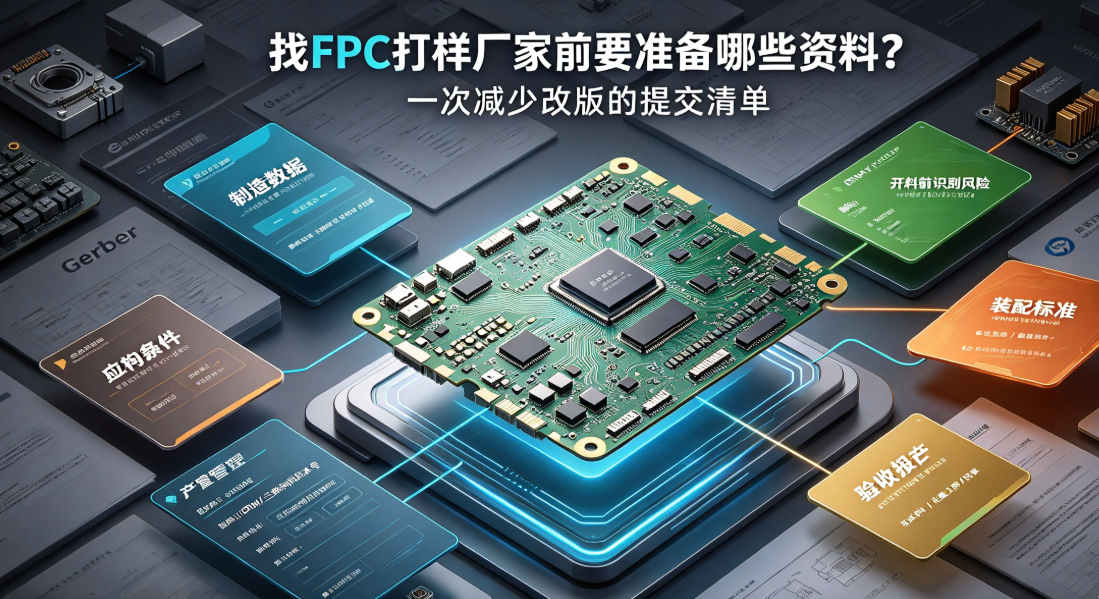
Slow FPC prototyping or repeated design iterations are often not due to manufacturing delays—but rather to missing information about application conditions, stack-up, assembly requirements, and acceptance criteria at order placement. This article outlines a comprehensive FPC prototyping checklist from the customer’s submission perspective, helping engineering teams obtain verifiable, production-ready samples faster.
Why do identical Gerber files yield significantly different prototype results?
Gerber data defines trace layout and board outline—but cannot fully specify how the FPC will bend, how it will be assembled, its operating temperature range, or which dimensions are critical for mating. If an FPC prototyping manufacturer must infer application intent solely from drawings, the sample may pass electrical continuity testing yet fail during dynamic flexing, connector engagement, or housing integration.
Clarify the validation objective before submitting documentation.
Initial prototypes may serve distinct purposes: verifying circuit functionality, dynamic flex life, mechanical fit, or SMT process compatibility. Each objective dictates differences in sample quantity, material selection, inspection scope, and deliverables. We recommend stating the primary validation goal prominently on the first page of both quotation requests and engineering review packages—to prevent the manufacturer from defaulting to basic continuity-only sampling.
A complete set of FPC prototyping documentation:
- Manufacturing data:Gerber files, drill files, outline data, stack-up specification, finished board thickness, copper weight, and surface finish.
- Structural data:3D model, mechanical reference datums, bending direction, minimum bend radius, and non-compressible zones.
- Application conditions:Operating temperature range, actuation frequency, signal type (e.g., high-speed, power), expected service life, and environmental exposure (e.g., humidity, chemicals).
- Assembly documentation:BOM, pick-and-place coordinates, stencil requirements, connector part numbers, and reflow profile specifications.
- Acceptance criteria:Critical dimensional tolerances, electrical test requirements, impedance targets, flex-cycle performance, visual inspection standards, and functional validation protocols.
Version control is the lowest-cost method to reduce rework.
Drawings, BOMs, and 3D structural models must share a single, unambiguous revision number. Revisions must explicitly identify changed items, indicate whether prior versions are obsolete, and define disposition instructions for in-process materials. Many so-called 'manufacturer errors' actually stem from cross-departmental use of mismatched revisions—wasting time and obscuring accountability.
Prototype materials should closely match production-grade specifications.
Using interim materials or experimental equipment for prototypes risks uncovering warpage, lamination, or trace integrity issues only after mass production begins. For high-reliability applications—including automotive and robotics—the prototyping phase must confirm which materials and processes are mandatory for production consistency, and which parameters can be refined in subsequent iterations.
How to conduct prototype acceptance upon receipt:
- Verify test reports, material lot traceability, critical dimensions, and visual quality.
- Perform electrical continuity, impedance, or functional testing per specification.
- Assemble using actual or equivalent fixtures to assess interference, tensile stress, and connector engagement.
- Execute bending, vibration, or thermal cycling tests along the intended operational trajectory.
- Categorize observed issues into four root-cause groups—design, material, process, and assembly—and generate a closed-loop action list for the next revision.
Hongyi Precision provides FPC engineering evaluation, rapid prototyping, and follow-on FPCA services. The more complete the submitted documentation, the earlier our engineering team can identify risks during material release—and the closer the prototype aligns with final production requirements.