
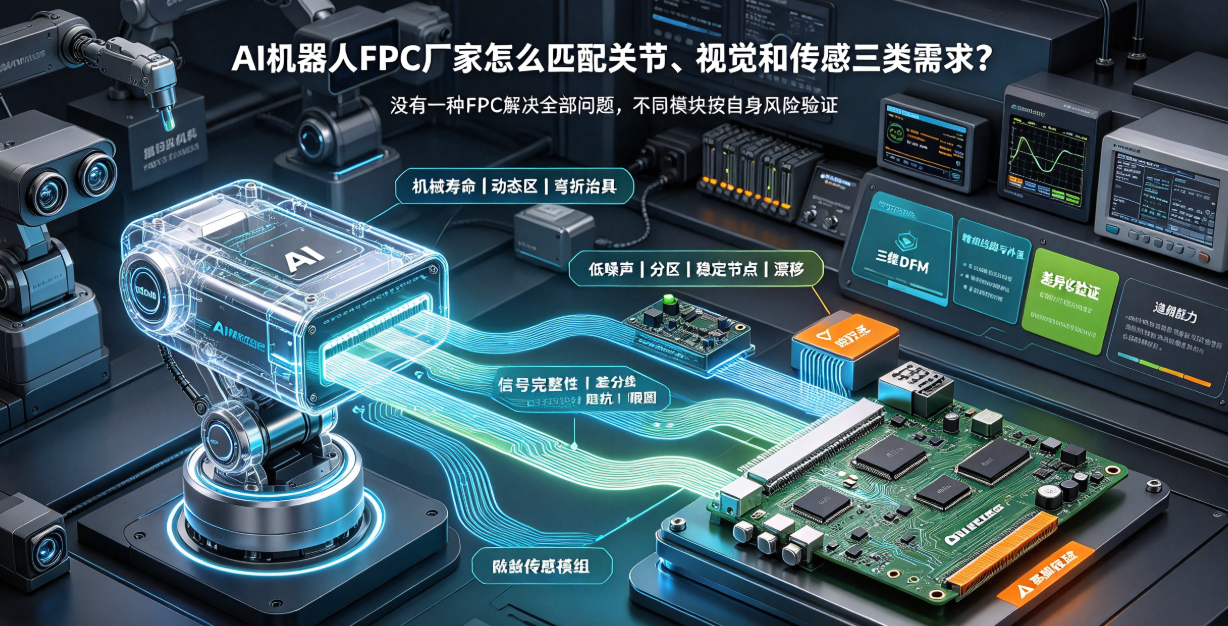
Different modules in AI robots impose distinct requirements on FPCs: joints emphasize dynamic service life; vision systems demand high-speed signal integrity; and end-effectors prioritize low-noise, high-density interconnects. This article outlines the design, process, and validation capabilities customers should verify when selecting an FPC supplier for AI robots—using three representative modules as examples.
There is no single FPC solution that satisfies all robotic subsystem requirements.
Joints, vision systems, and end-effectors all rely on flexible interconnects—but their dominant failure modes differ. Joint traces undergo repeated bending; vision traces carry high-speed data; and end-effector sensors are highly sensitive to electrical noise and minute resistance variations. An FPC supplier relying solely on standardized materials and generic testing cannot reliably meet all three requirements simultaneously.
Joint Module: Mechanical Life Comes First
Engineering review must include 3D geometry, motion axes, maximum angular displacement, cycle frequency, and mounting methodology. Dynamic zones must avoid vias, pads, and stiffener edges; trace routing should align with primary motion direction. Copper foil, coverlay, and adhesive systems must be selected to match required bend radius and operating temperature range. Validation must use actual or equivalent assembly fixtures.
Vision Module: Signal Integrity Is Paramount
Cameras and depth sensors operate at high data rates. Differential pair width, spacing, length matching, and reference plane continuity are critical. Connectors, vias, windowed areas, and bend transitions can all introduce impedance discontinuities. Suppliers must provide impedance design support, measurement capability, and—if needed—eye diagram or bit-error-rate validation methodology—not just continuity testing.
End-Effector Sensing: Low Noise and Assembly Stability Are Equally Critical
Dexterous hands and tactile arrays involve multiple sensitive analog signals. Sensor traces must be physically segregated from motor drive and power switching lines. Local sensor nodes must remain mechanically stable, while designated dynamic relief zones absorb bending strain. Connector mounting, stiffener application, and adhesive bonding must prevent transmission of assembly stress to sensing elements.
Four Shared Capabilities to Verify When Selecting a Supplier
- Ability to interpret 3D mechanical data and actively participate in routing and assembly DFM.
- Proven experience in fine-line patterning, multilayer or rigid-flex construction, stiffener integration, and connector compatibility.
- Capability to develop customized validation plans—including flex cycling, vibration, thermal, and electrical performance tests—for each module type.
- Consistent documentation and traceability—from prototype through volume production—for materials, key parameters, AOI results, electrical test data, and lot-level records.
Validate engineering assumptions with functional prototypes—not by chance.
For first-run prototypes, define independent success criteria per module type: joint FPCs validated for cycle life; vision FPCs for signal integrity; sensing FPCs for noise floor and drift stability. Hongyi Precision offers differentiated FPC design evaluation and volume-production support tailored to AI robot joints, vision systems, and sensing interfaces—ensuring each module is verified against its specific risk profile.