
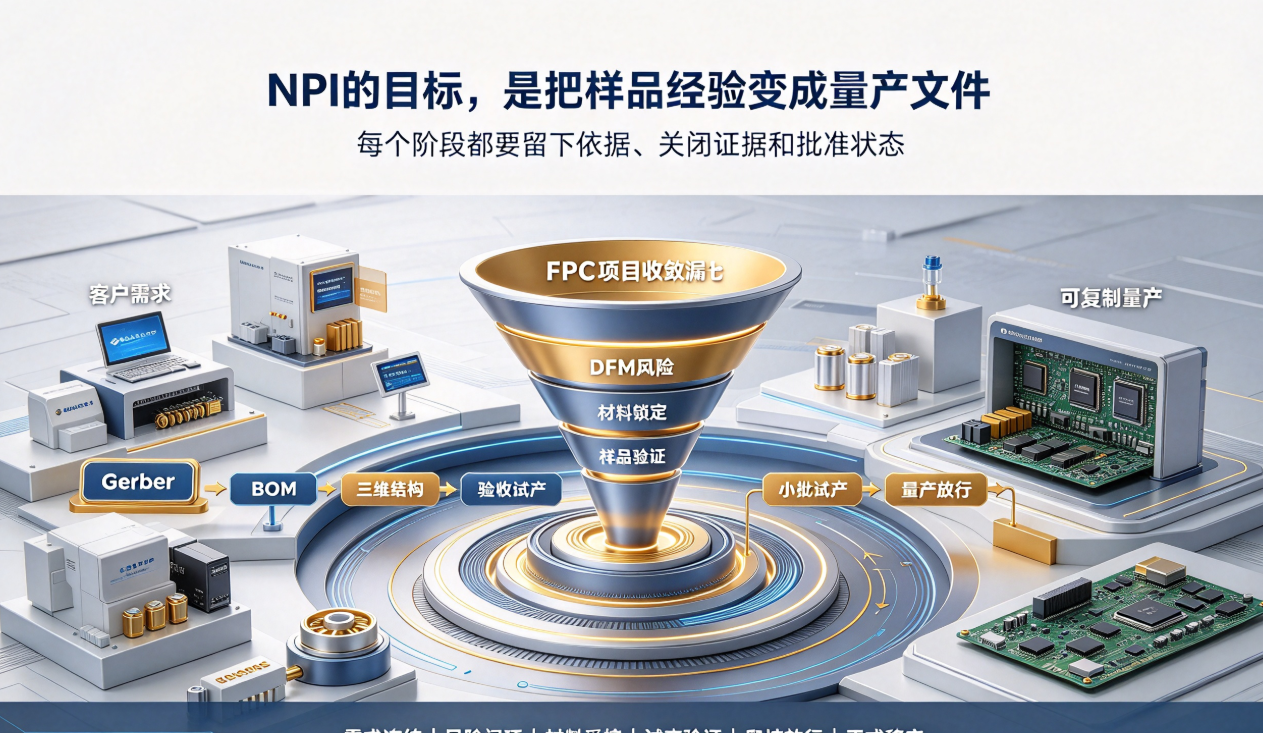
NPI introduction for FPC manufacturers cannot be judged solely on sample qualification. This article outlines the project management methodology for flexible printed circuit boards—from R&D to mass production—across seven phases: requirement freeze, DFM, material and process definition, sample validation, pilot run, ramp-up, and engineering handover.
Key takeaway:For FPC projects, the real challenge is not producing the first sample—but systematically freezing customer requirements, engineering data, material specifications, inspection methods, and delivery schedules, then ensuring consistent replication across batches. A professional FPC manufacturer must treat NPI introduction as a phased management process—not a one-time handoff of samples to production.
Procuring materials before requirement freeze, entering prototyping without Gerber review, or scheduling mass production before sample issues are resolved often leads to repeated design revisions, schedule slippage, batch-to-batch inconsistency, and unclear accountability. The more rigorously NPI is managed per phase, the smoother the ramp-up.
Phase 1: Confirm Requirements and Project Scope
At project kickoff, the FPC manufacturer must jointly confirm product application, mechanical structure, interface specifications, volume, delivery milestones, and acceptance criteria. Gerber files are only foundational inputs; BOM, stack-up, base materials, stiffeners, connectors, 3D assembly drawings, bend path profiles, temperature/vibration limits, current-carrying capacity, and impedance requirements must also be collected.
Operating conditions differ significantly among automotive electronics, electronic shifters, and robotic dynamic FPCs. Requirements must explicitly identify Critical-to-Quality (CTQ) parameters, those eligible for optimization during DFM, and those requiring formal customer approval for any change.
Phase 2: Complete DFM Review and Risk Register
Engineering review must consolidate all critical items—including trace routing, hole placement, pad geometry, stiffener layout, coverlay windowing, minimum bend radius, connector-end thickness, and assembly clearance—into a single risk register. Each item must specify impact, recommended action, owner, target closure date, and objective evidence of resolution.
A simple 'manufacturable' response in DFM review does not confirm that risks have been mitigated. A qualified DFM output translates design boundaries into explicit material, process, inspection, and validation requirements—and must be formally approved by the customer.
Phase 3: Lock Materials, Process, and Sample Plan
During sampling, specific models, thicknesses, and lot-control rules must be confirmed for PI substrate, copper foil, coverlay, adhesive system, stiffeners, and surface finish. Any use of temporary materials, manual stiffening, or non-standard processes must be documented with justification and limitations—sample results must never be assumed directly transferable to mass production.
Simultaneously, panelization scheme, process flow, key equipment, inspection fixtures, test programs, and sample quantity must be finalized. For dynamic bend or FPCA applications, assembly jigs, functional test setups, and reliability validation conditions must also be pre-confirmed.
Phase 4: Validate Design and Assembly Using Samples
Engineering samples must verify dimensional accuracy, connector fit, stiffener positioning, coverlay window alignment, assembly clearances, bend path compliance, and core functionality—not just electrical continuity. Sample issues must be categorized by root cause (design, material, manufacturing, or assembly) and tracked to formal closure.
If rework or ad-hoc modifications are applied to samples, changes must be clearly annotated—and samples must be explicitly labeled either as 'design verification units' or 'mass-production process verification units.' Blending these two types risks misinterpretation by customers.
Phase 5: Validate Replication Capability via Pilot Run
The pilot run must utilize materials, equipment, process parameters, inspection methods, and personnel aligned with the intended mass production plan—not continued reliance on engineer-led manual selection. Key metrics include first-article pass rate, dominant defect types, rework ratio, cycle time, material yield loss, and test stability.
When anomalies occur, avoid focusing solely on final yield. Determine whether issues stem from random defects, systematic process deviations, or input specification changes—and verify that corrective actions can be reliably replicated in subsequent lots.
Phase 6: Establish Mass Production Release and Ramp-Up Rules
Mass production release criteria must explicitly define approved drawing revision, material status, first-article conclusion, process capability indices, reliability test completion, inspection report status, and required customer approvals. Ramp-up must follow defined lot-by-lot targets to progressively validate yield, cycle time, labor utilization, and equipment loading.
Tight customer deadlines must never justify skipping unresolved issues or scaling pilot-run processes directly to high-volume production. Staged deliveries are acceptable—but each shipment must carry unambiguous release status and full traceability records.
Phase 7: Formal Engineering-to-Manufacturing Handover
NPI completion does not end with sample delivery. It requires formal transfer of controlled drawings, BOM, process flowcharts, work instructions, inspection standards, test procedures, packaging labels, nonconformance handling protocols, and change control rules to manufacturing and quality teams.
Post-handover, the project risk register—including open issues, pending risks, and customer-specific requirements—must remain active. Subsequent changes to materials, equipment, subcontractors, or processes must undergo formal change evaluation—not field-level adjustments.
FPC Manufacturer NPI Readiness Checklist
Requirements, drawings, BOM, 3D structure, and acceptance boundaries are frozen;
DFM risks have assigned owners, deadlines, and verified closure evidence;
Materials, processes, equipment, inspection fixtures, and test methods are fully traceable;
Sample-based design verification is clearly separated from mass-production process verification;
Pilot runs are executed under controlled conditions closely matching planned mass production;
Mass production release criteria, ramp-up plan, and staged delivery rules are formally agreed;
Formal handover is completed among engineering, manufacturing, quality, procurement, and customer teams.
How to Assess an FPC Manufacturer’s NPI Capability
Request stage-gated deliverables: input checklists, DFM records, sample reports, pilot-run data, issue closure logs, and mass production handover documentation. A truly capable NPI partner does not merely showcase a finished sample—it articulates the rationale behind every status transition from design through to mass production.
Dongguan Hongyi Precision Circuit Co., Ltd. supports automotive electronics, humanoid robotics, and consumer electronics projects with drawing review, DFM analysis, engineering prototyping, assembly validation, pilot-run introduction, reliability verification, FPCA integration, and volume production. Specific phase timelines, delivery schedules, and release conditions are governed by customer drawings, product structure, order volume, and mutually approved documents.
For early-stage design guidance, refer toDFM Review Methodology for FPC Manufacturers, for first-article release, refer toKey Evidence for First-Article Approval in FPC Manufacturing, and for in-process quality control, refer toIn-Process Inspection and Nonconforming Lot Release Protocols for FPC Manufacturers.
Summary:The essence of successful NPI introduction lies in progressive convergence—of requirements, design, materials, processes, validation, and production—at each phase. Only when FPC manufacturers convert sample-level experience into reproducible, documented mass production files and data can they genuinely help customers shorten time-to-market and mitigate volume-production risk.