
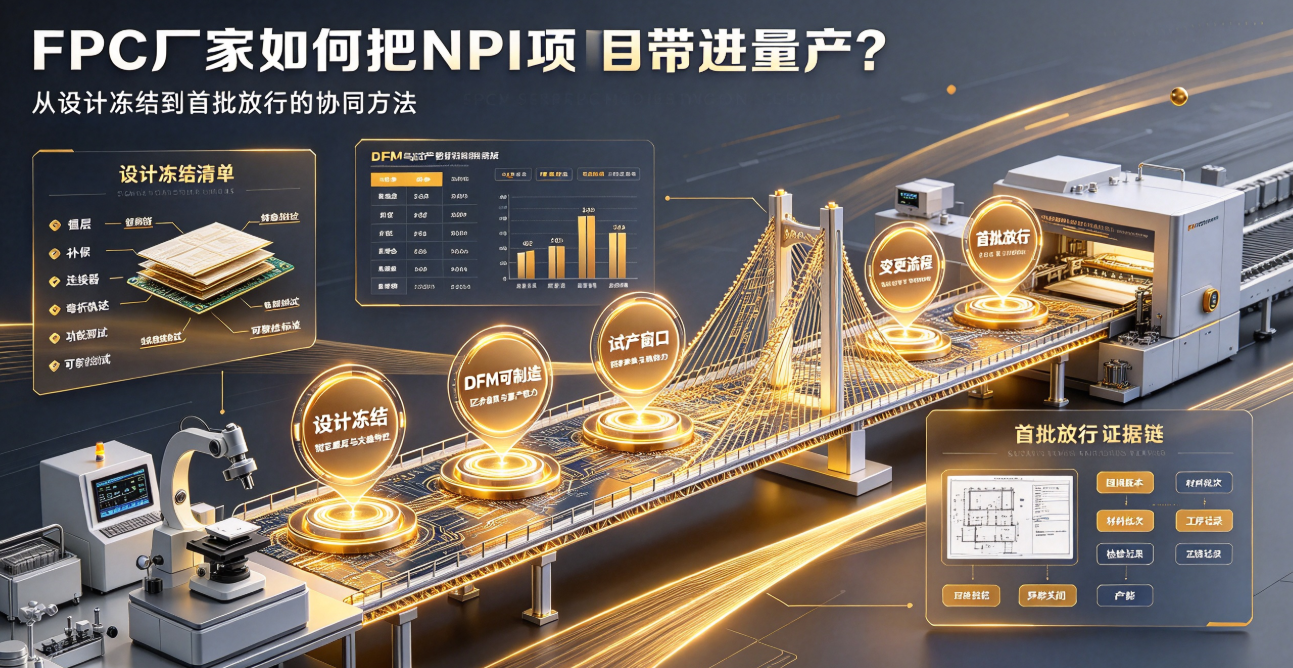
FPC projects are most vulnerable to loss of control after sample approval but before mass production begins. This article outlines five critical phases—design freeze, process window definition, pilot run data analysis, change management, and first batch release—to help customers assess whether an FPC manufacturer truly possesses the capability to bridge NPI and mass production.
Bottom line:When selecting an FPC manufacturer, customers should evaluate not only whether samples can be produced—but also whether those same materials, equipment, and inspection logic can consistently replicate results at scale. The true deliverable of the NPI phase is not merely a few qualified samples, but rather a validated, repeatable manufacturing process supported by documented quality evidence.
Many FPC projects perform normally during sampling but encounter warpage, misaligned stiffeners, line width variation, or inconsistent assembly during pilot runs. These issues rarely stem from sudden degradation in one operation; instead, they reflect unaddressed temporary conditions from the sampling stage that were never formalized into mass production controls.
Stage One: Define Design Freeze Clearly
Design freeze should extend beyond Gerber file finalization. Customers must simultaneously lock down stack-up, polyimide (PI) and copper foil specifications, coverlay, stiffeners, surface finish, connectors, 3D assembly requirements, bend trajectory, functional test protocols, and reliability standards. Any outstanding document revision prevents the FPC manufacturer from establishing a stable process window.
We recommend explicitly identifying critical characteristics in the freeze checklist—for example, connector-end thickness, bend initiation point, mounting hole location, impedance, minimum trace/space, and local stiffener boundaries—so engineering, procurement, and quality teams operate from identical reference criteria.
Stage Two: Translate DFM Feedback into Manufacturable Parameters
Valuable DFM input should specify risk locations, recommended values, impacts on cost and lead time, and required verification tests. Examples include whether vias in dynamic zones intersect primary bend paths, whether coverlay openings expose pad edges, or whether irregular outer contours necessitate adjustments to tooling or panel margins.
FPC manufacturers must also distinguish between lab-level capability limits and stable mass production capability. What customers truly require are sustainable trace width, hole diameter, registration, and dimensional tolerances at target volumes—not one-off prototypes pushing theoretical limits.
Stage Three: Validate the Process Window During Pilot Runs
Pilot runs must go beyond pass/fail records. Key process parameters—including exposure, etching, lamination, coverlay application, routing, surface finish, and electrical testing—should be logged alongside first-article results, defect types, scrap reasons, and rework boundaries. Consistent multi-batch data provides stronger evidence of process stability than peak yield from a single lot.
For automotive and robotics applications, pilot runs should also include bending, vibration, or functional testing under near-real assembly conditions. Passing bare-board tests does not guarantee performance post-assembly—where tensile stress, friction, or intermittent contact may occur.
Stage Four: Institutionalize Change Control from the Sampling Phase
Material substitutions, equipment changes, stiffener supplier shifts, test program updates, and panel layout modifications can all invalidate prior validation. FPC manufacturers must implement a structured change management system—including classification, impact assessment, customer notification, revalidation, and obsolete material quarantine—rather than relying on ‘specification equivalence’ as a substitute for verification.
Stage Five: First Batch Release Requires a Complete Evidence Chain
Consistent version control across drawings, BOMs, stack-ups, process documents, and inspection standards;
Full traceability linking material lots, critical process steps, inspection results, and shipment batches;
Closure of all pilot-run open items—or implementation of interim measures approved in writing by the customer;
Use of approved materials and key equipment across samples, pilot runs, and first batch production;
Clear definitions of mass production yield targets, capacity, packaging specifications, and response windows for nonconformances.
Hongyi Precision establishes continuous project milestones for FPC programs—from drawing review and material confirmation through engineering sampling, pilot ramp-up, and volume delivery. For customers, a truly long-term FPC partner is one that ensures every NPI milestone is backed by data, assigned ownership, and formal closure—not just verbal commitments made during quotation.
Summary:The key to successful NPI-to-mass-production transition lies not in maximizing production speed, but in systematically freezing and documenting design, materials, processes, validation outcomes, and change management—creating a fully traceable, auditable release basis.