
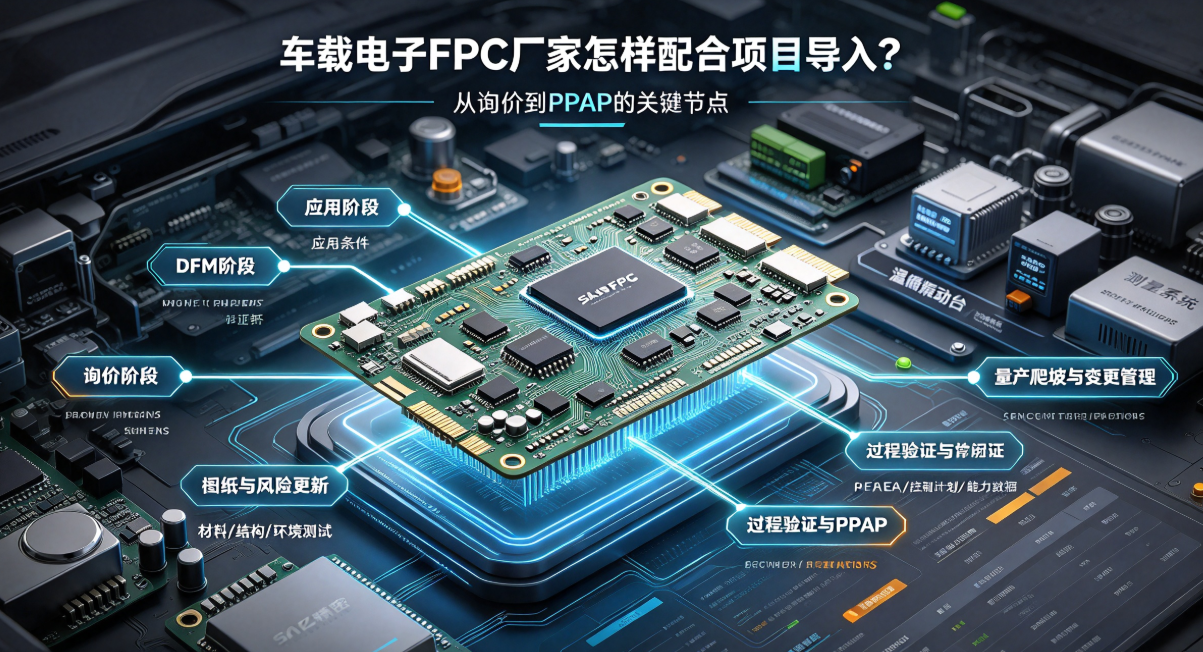
From quotation to mass production, automotive electronic FPC development involves requirement clarification, DFM, prototype build, design validation, process validation, and PPAP. A supplier’s ability to deliver correct documentation and close risks at each stage directly impacts project timeline. This article outlines the project launch responsibilities of automotive electronic FPC suppliers.
Automotive projects are not 'produce immediately after drawing approval.'
Automotive component development entails long cycles and multiple stakeholders. FPCs must meet both functional performance requirements and consistent manufacturing takt time and change management expectations. If an FPC supplier assumes only a fabrication role, risks often surface late in validation. A more effective collaboration model requires the supplier to provide objective evidence at each project milestone.
Quotation Stage: Translate Application Requirements into Technical Inputs
Beyond Gerber files and quantity, clarify mounting location, operating temperature, vibration profile, dynamic flexing, signal type, expected service life, annual volume, and critical timing milestones. This enables the supplier to assess material selection, stack-up, stiffener requirements, trace design, and validation cost—avoiding quotations based on generic consumer-electronics assumptions.
DFM Stage: Close the Design-to-Manufacturing Interface
DFM review must cover flex zones, vias, pads, stiffeners, connectors, alignment features, test points, and assembly clearance. Approved modifications must be reflected in formal drawings and synchronized updates to risk analysis (PFMEA) and inspection requirements. Verbal or email-only approvals risk version mismatches during mass production.
Prototyping and Design Validation: Prove the Solution Functions
Prototypes verify functionality, fit, and preliminary reliability. Design validation must use materials and construction approaching final specifications, tested under defined conditions—including temperature, vibration, flex cycling, damp heat, or signal integrity. Nonconformances must be root-caused by design, material, process, or assembly—and resolved with documented closure evidence.
Process Validation and PPAP: Prove the Factory Can Repeat It
Process validation focuses on production equipment, fixtures, personnel, takt time, and yield. Process flow diagrams, PFMEA, control plans, measurement system analysis (MSA), and process capability data in PPAP submissions must match actual shop-floor conditions. Customers audit not just document completeness—but whether documents explain how product quality is controlled.
Ramp-Up and Change Management
- Initial mass-production lots must record actual yield, defects, and capacity bottlenecks.
- Special characteristics must be continuously recorded per the control plan and subjected to trend analysis.
- Changes to materials, equipment, tooling, or process parameters must be validated per severity level and formally communicated to the customer.
- Nonconformances require immediate containment of affected lots, followed by root-cause analysis and implementation of permanent corrective actions.
Hongyi Precision leverages its IATF 16949-certified system to support automotive electronic FPC projects across engineering review, prototyping, small-batch builds, PPAP execution, and full-volume delivery. The earlier the supplier engages, the more effectively structural and process risks can be closed prior to mass production.