
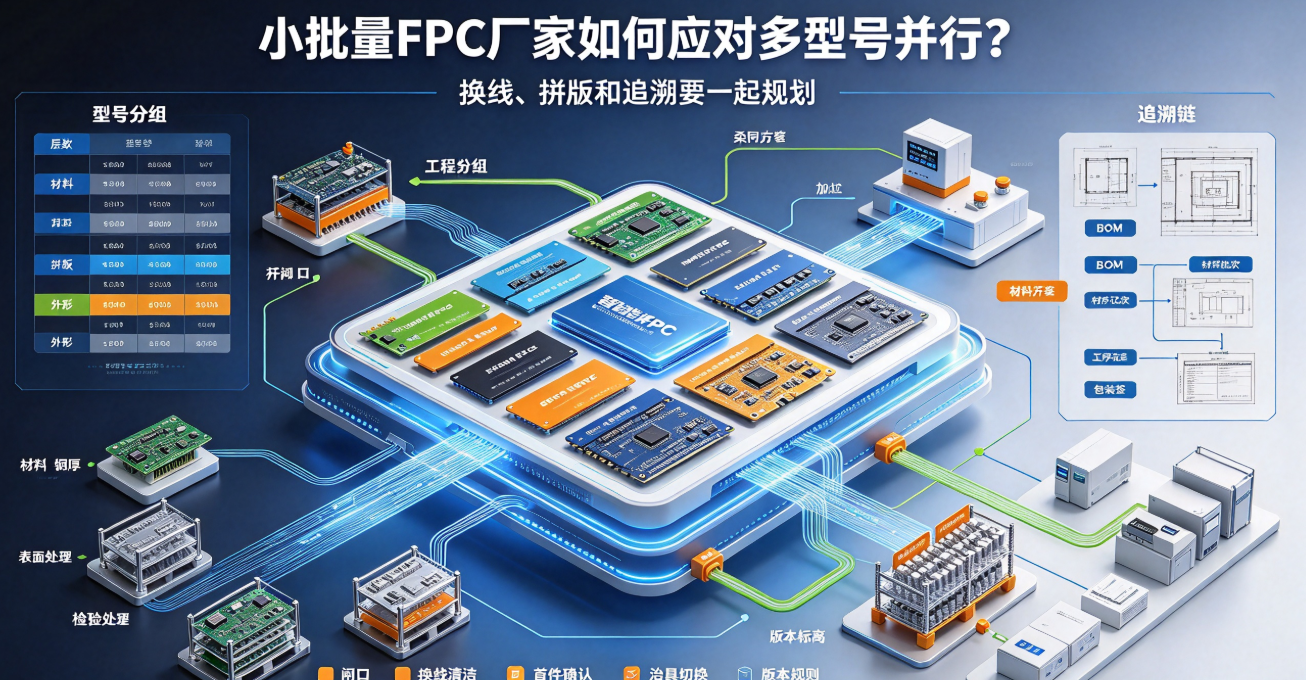
R&D projects rarely involve just one model—they typically advance multiple versions simultaneously, with low volumes and frequent revisions. This article outlines key management priorities for small-batch FPCs, covering production grouping, material preparation, line-change losses, panelization, batch segregation, and replenishment mechanisms.
Small-batch FPC orders are common in robotics R&D, medical instrumentation, new automotive programs, and consumer electronics iteration. Low volume does not equate to simple management—instead, concurrent multi-model production, frequent drawing revisions, incomplete material kits, and overlapping delivery dates are typical. A capable small-batch FPC manufacturer must deliver both agility and process control.
Group multi-model orders first by process similarity.
Scheduling must not follow only customer order sequence. Models with similar layer count, base material, copper thickness, surface finish, outline processing, and inspection methods can share engineering, blanking, and certain process steps—reducing line changes, cleaning cycles, and fixture swaps.
However, similarity does not permit mixing. Distinct drawings, material grades, stiffeners, and connector-end thicknesses must be clearly differentiated in both ERP systems and shop-floor labeling—never mixed across lots solely to improve equipment utilization.
Material readiness is more critical than equipment scheduling.
Small-batch projects often specify particular PI films, copper foils, coverlays, and stiffeners—inventory levels may not align with high-volume generic production. Before scheduling, verify material lot numbers, expiration dates, storage conditions, and approved substitution rules to avoid mid-production line stoppages due to missing materials.
Line-change losses must be calculated upfront.
Line changes incur equipment cleaning, parameter validation, first-article inspection, fixture swaps, and operator wait time. Quotations and lead times should separate these one-time costs from recurring processing costs. If customers plan ongoing replenishment orders, standardized materials, fixtures, and inspection procedures can reduce repeated line-change losses.
Panelization optimization must serve product functionality.
To lower material cost, small-batch FPCs often use multi-model panelization or maximize panel utilization. However, copper grain direction, bend direction, branch location, process rails, and dimensional accuracy all require adequate margins. Over-compressing spacing risks edge defects, punching deformation, or handling-induced damage.
Revision segregation is non-negotiable for small-batch projects.
Each revision must have distinct drawings, BOMs, materials, processes, inspection criteria, and packaging labels. On the shop floor, status must be clearly marked for pending review, accepted, rework, and scrap; leftover materials from prior revisions must never be stored or used with newer revisions. When issues arise, rapid answers to 'Which revision? Which lot? Which materials? Which customers?' are essential.
Replenishment order planning must begin with the first batch.
The initial batch should use planned mass-production materials and critical equipment wherever possible;
Capture actual labor hours, yield, defect types, and material loss data;
Record fixture life, program version, and manual verification points;
Predefine replenishment cycle time, minimum order quantity, and inventory strategy;
Integrate trial-production issues into the formal control plan before ramp-up.
Hongyi Precision supports continuous FPC delivery—from R&D samples and small-batch trial production through to full-scale manufacturing. When selecting a small-batch FPC supplier, customers should prioritize multi-revision management, line-change control, and mass-production handover capability—not just unit price of an initial sample batch.