
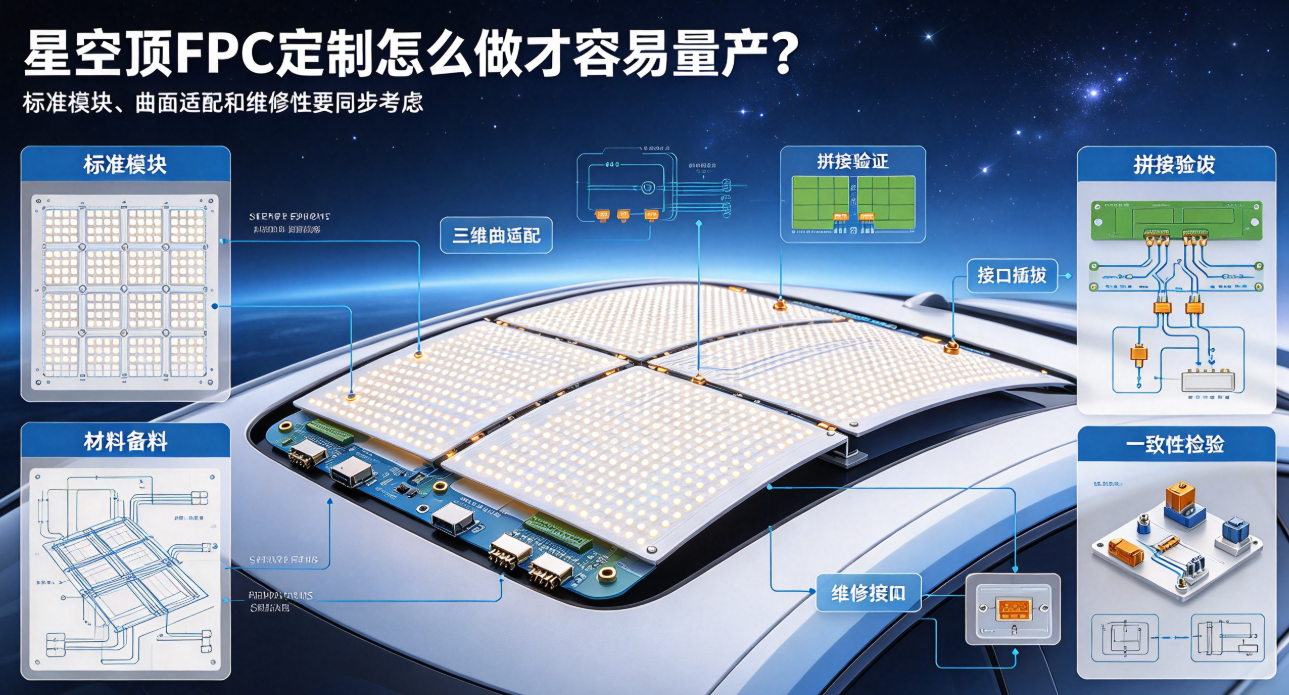
Starry-sky roof FPC customization is not merely about drawing a circuit layout to match the roof dimensions—it also requires careful planning of module segmentation, interconnection interfaces, curved-surface conformability, control zoning, and after-sales replacement. This article outlines a production-ready customization methodology grounded in real project execution.
When customers request custom starry-sky roof FPCs, they typically begin by specifying roof length/width and LED count. However, true project readiness hinges on additional factors: how modules are segmented, how power is distributed, how interconnections are positioned and aligned, how the FPC conforms to complex curvature, and how individual sections can be replaced post-installation. A single large-panel design based solely on outer contour dimensions is not necessarily optimal for mass production.
First, choose between modular or monolithic design
Monolithic designs minimize interconnects and seam lines but require large-format substrates—increasing handling complexity and lamination difficulty. Modular designs offer greater flexibility across vehicle platforms and simplify maintenance, yet demand tight control over optical continuity, electrical integrity, and assembly tolerances at interconnection points. Selection should consider roof dimensions, projected volume, assembly line constraints, and after-sales service strategy.
Why standard modules reduce customization risk
For common vehicle types—including sedans, SUVs, and MPVs—establishing a library of standard-length/width modules or predefined zoning patterns enables efficient model adaptation via edge trimming, interconnection methods, and control firmware tuning. Standardization supports shared materials, fixtures, inspection protocols, and inventory planning—reducing time and cost associated with per-model tooling development.
Curved-surface adaptation requires 3D analysis—not just 2D unfolded drawings
Longitudinal and transverse roof curvature, sunroof openings, trim panel clip locations, and harness routing paths all impact FPC conformability. Passing 2D dimensional checks does not guarantee wrinkle-free, edge-lift–free, or clip-damage–free installation. Engineering reviews must use 3D CAD data to verify bend radii, mounting point placement, and edge margin allowances.
Interconnection interfaces must accommodate both assembly and service logic
Connectors, solder joints, or conductive contact zones should avoid areas of abrupt curvature change or mechanical stress concentration. Surrounding interface regions require precise alignment features, localized stiffeners, and sufficient clearance for mating/unmating. If field replacement of individual modules is required, interface locations must remain accessible to technicians—not fully concealed within non-removable structural assemblies.
Control zoning directly impacts cost and optical performance
More zones increase lighting control flexibility—but also raise component count, connector complexity, driver channel requirements, and test coverage. Define zoning based on lighting scenarios, ECU interface capability, and power budget—not by default assigning independent circuits to every small region.
Custom projects are recommended to progress through four prototype stages:
Structural prototype: validates curvature fit, clip engagement, interface positioning, and assembly clearances;
Electrical prototype: verifies zoning logic, brightness uniformity, control responsiveness, and power consumption;
Process prototype: confirms large-panel lamination, module interconnection, final outline accuracy, and inspection feasibility;
Production prototype: validates batch-to-batch consistency under full production materials, equipment, and tooling conditions.
Hongyi Precision provides end-to-end support for starry-sky roof FPC customization—including dimensional assessment, module architecture design, prototyping, interconnection validation, and mass-production ramp-up. Integrating standardized modules with vehicle-specific adaptations typically delivers shorter development cycles, lower costs, and improved lot-to-lot consistency versus ground-up design for each program.