
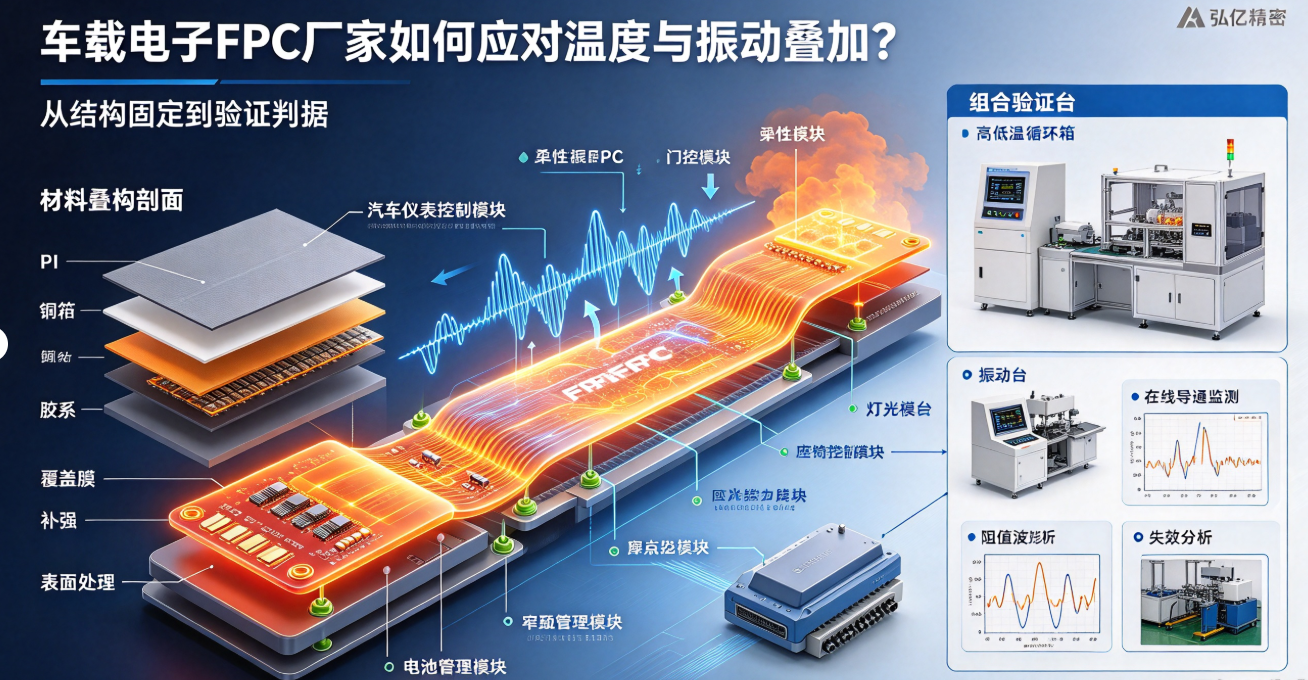
Automotive FPCs in real vehicles simultaneously endure temperature extremes, vibration, assembly stress, and resistive heating. This article outlines key design considerations—from application conditions and material stack-up to fixation points, connectors, and combined thermal cycling and vibration validation.
The actual operating environment for automotive FPCs is rarely isolated high temperature or vibration alone—it typically involves simultaneous temperature fluctuations, vehicle vibration, mechanical constraints from assembly, and resistive heating from current flow. Some samples pass static lab tests but later exhibit intermittent opens, delamination, solder joint cracking, or unstable connector contact after vehicle installation—often due to cumulative multi-stress effects.
First, translate mounting location into operational conditions.
Automotive FPC manufacturers must identify whether the product is installed in instrument clusters, door modules, seat controls, shifters, lighting units, or battery-related systems. Each location presents distinct temperature ranges, vibration directions, humidity/oil exposure, bending frequency, and service requirements—validation plans cannot rely on a single generic checklist.
Material selection and stack-up must align with both thermal and dynamic demands.
Polyimide (PI), copper foil, coverlay, adhesive system, stiffener, and surface finish collectively influence coefficient of thermal expansion (CTE), flex-life durability, and solder joint reliability. Dynamic zones require flexibility and fatigue resistance, while connector and fixation zones demand dimensional stability and mechanical support.
Stack-up design must also account for current-induced heating, impedance control, and insulation clearance. Increasing copper thickness to improve current-carrying capacity may alter lamination fill and bend stiffness—thus requiring integrated structural evaluation.
Fixation points should constrain motion—not induce tensile stress.
Too few fixation points allow the FPC to flap against the housing during vibration; too many—or poorly positioned ones—concentrate thermal expansion and vibrational displacement at narrow necks, stiffener edges, and connector roots. Designers must clearly define free, transition, and fixed segments—and accommodate assembly tolerances.
Connectors and solder joints must be integrated into the load path.
Connector locking mechanism, end thickness, exit direction, and retention force directly impact contact reliability. If mechanical loads transmit through solder joints or connectors, thermal cycling may cause contact resistance variation and solder fatigue. Assembly-level validation must assess interactions between connectors, housings, harnesses, and adjacent components.
Combined validation better reflects real-world vehicle conditions than single-stress testing.
Assemble and power the FPC within its actual or equivalent housing;
Perform temperature cycling (e.g., -40°C to +125°C) while monitoring continuity, resistance, functionality, and visual integrity;
Superimpose vibration or actuation cycles at critical temperature points;
Monitor sensitive signals in real time to capture transient interruptions;
Post-test inspection includes coverlay integrity, stiffener adhesion, solder joints, connector condition, and interlayer delamination.
Which records should be retained for automotive FPC projects?
Mounting location, temperature profile, vibration spectrum, and actuation conditions;
Drawing revisions, material specifications, connector part numbers, and assembly version control;
Test fixture details, powered-state configuration, and real-time monitoring thresholds;
Failure sample orientation, oscilloscope waveforms, photographs, and post-test cross-section analysis;
Verification conclusions for corrective actions implemented in subsequent production lots.
Hongyi Precision provides engineering support for automotive FPC and FPCA applications—including shifters, lighting, and sensing systems. When selecting an automotive FPC supplier, customers should evaluate whether the manufacturer integrates materials, structure, interconnects, process control, and full-vehicle validation—not merely certifies compliance with a single standard.