
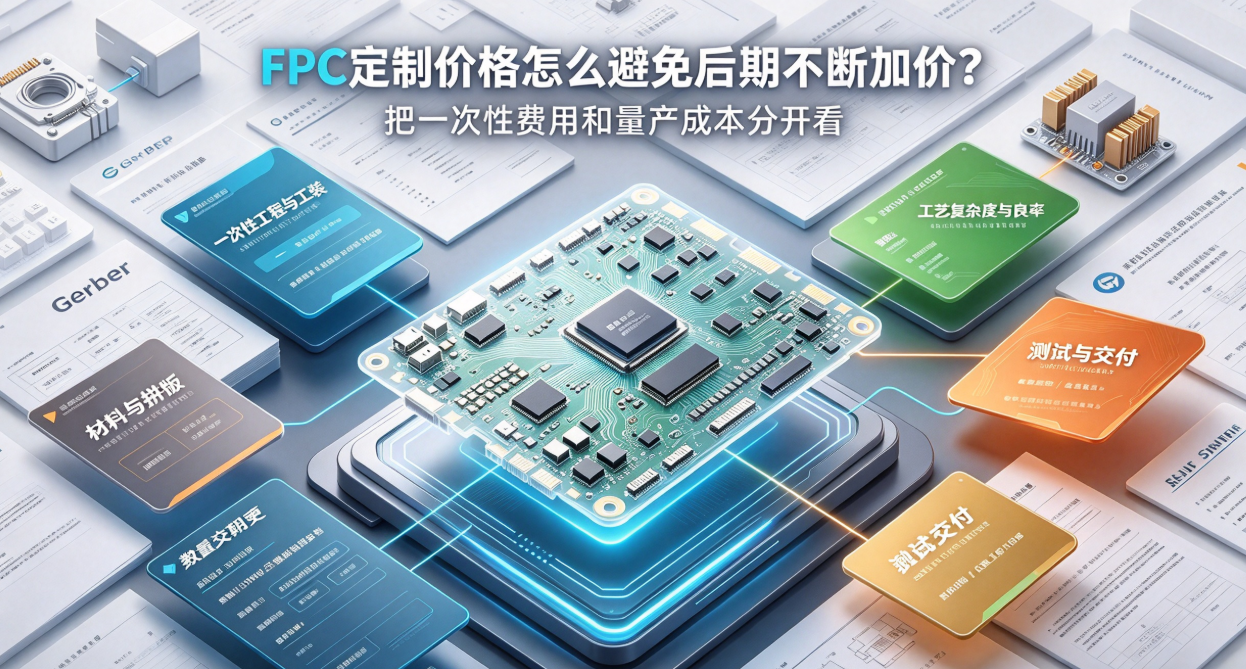
FPC customization cost is not determined by area and quantity alone. Engineering work, tooling, material utilization, yield, testing, SMT, packaging and engineering changes all affect total project cost. This guide helps purchasing teams compare quotations without sacrificing reliability.
When customers ask for an FPC customization cost, they often want one number per piece. In practice, the cost structure changes from prototype to mass production. Engineering and tooling are concentrated at the beginning, while materials, manufacturing, inspection, packaging and change management affect later deliveries. Comparing only one piece price can therefore lead to unexpected additional charges.
First layer: one-time engineering and tooling
Engineering review, panelization, tooling or laser programs, electrical-test fixtures, stencils and assembly fixtures are usually related to project launch and do not increase linearly with quantity. They should be listed separately, with clear rules for repeat orders, fixture life and reuse.
Second layer: material and panelization cost
PI, copper foil, coverlay, adhesive, stiffeners, surface finish and connectors form the basic material cost. Product dimensions, orientation, process borders and panel utilization determine the effective material consumed per piece. Compressing process borders or changing the bend direction only to improve utilization can increase scrap and assembly risk.
Third layer: process complexity and stable yield
Layer count, fine lines, small holes, impedance control, irregular outlines, large-area lamination, local stiffeners and special surface finishes all add process and inspection requirements. The quotation should be based on a sustainable production yield, not the best result from one trial lot. The real manufacturing cost is the material and labor consumed for each qualified piece.
Fourth layer: test and delivery scope
A bare FPC, an FPCA with SMT, a connector-assembled part, a function-tested sample and a reliability-validated part have different costs. The quotation should define AOI, electrical test, dimensions, impedance, bending, thermal cycling, sampling and report requirements. Necessary quality activities should not be left for later negotiation.
Fifth layer: quantity, lead time and engineering-change risk
Small lots must absorb setup, material preparation and fixture costs, while mass production is more sensitive to material procurement, capacity, yield and inventory. Expedite requests can change the production plan and logistics cost. Changes to drawings, materials or processes may require new prototypes and validation, so the commercial boundary should be agreed in advance.
Three safer ways to reduce cost
Relax tolerances and extreme parameters that are not functionally necessary during DFM.
Improve utilization through outline, panelization, standard modules and material selection.
Use pilot-lot data to improve bottleneck-process yield and reduce scrap.
A practical comparison table for FPC quotations
Are the drawing, materials, stack-up, quantity and delivery date the same?
Are engineering, tooling, stencil and test-fixture charges listed separately?
Which processing, inspection, SMT and packaging activities are included?
What panelization, yield assumption and material-stock condition support the price?
How are changes, abnormalities, repeat orders and expedite requests handled?
Hongyi Precision recommends comparing FPC customization costs against a complete technical and delivery scope. A sound quotation makes total project cost predictable and does not achieve a low headline price by downgrading materials or removing necessary inspections.