
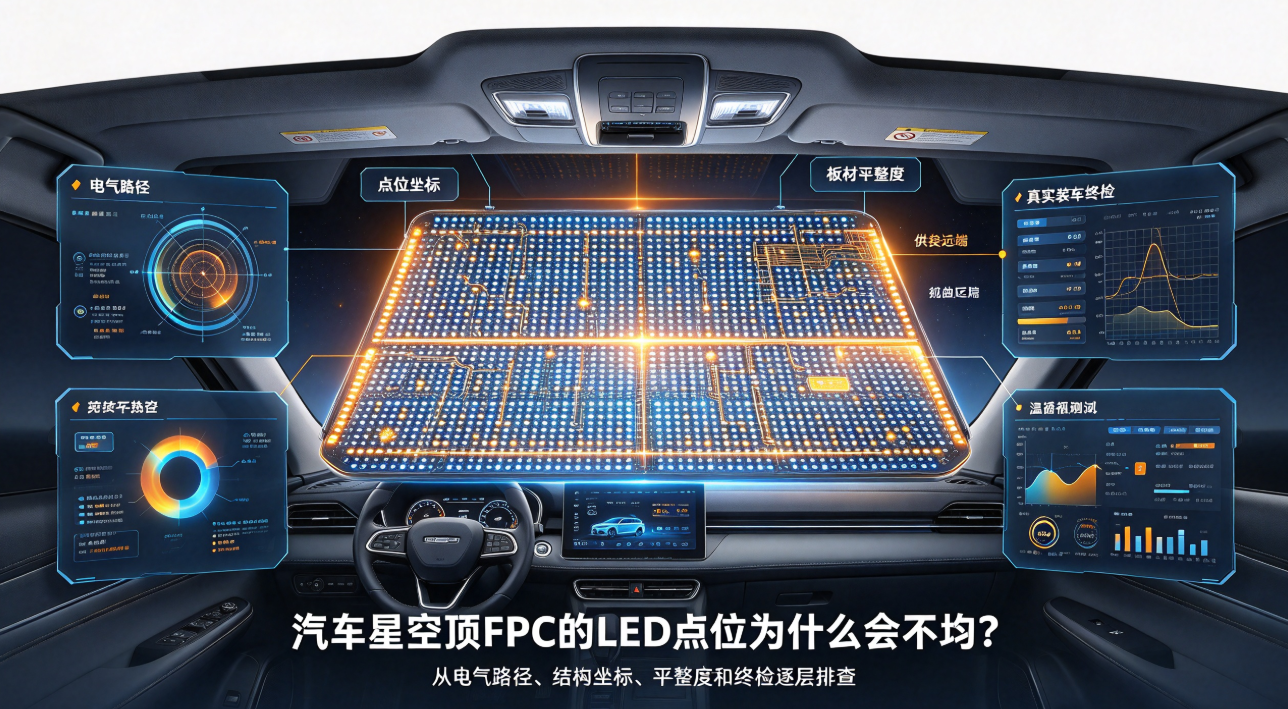
When localized dark spots, brightness inconsistencies, or visible seam boundaries appear on an automotive starry-sky roof FPC, root causes may simultaneously stem from voltage drop, LED positional tolerance, FPC warpage, and headliner assembly. Relying solely on LED-on verification rarely identifies systemic batch issues. This article outlines a systematic diagnostic framework across three parallel dimensions: electrical path, substrate dimensional accuracy, and assembly reference alignment.
Uneven 'star points' on a starry-sky roof do not necessarily indicate LED defects.
An automotive starry-sky roof comprises numerous micro-light sources; consumers expect a continuous, uniform starfield effect. Any localized voltage deficiency, inconsistent LED height, regional FPC warpage, or misaligned splicing will manifest visually as dark spots, hotspots, or seam boundaries. Addressing such issues by replacing LEDs alone often leads to repeated rework without resolving the root cause.
When diagnosing unevenness in automotive starry-sky roof FPCs, first categorize observed anomalies into electrical non-uniformity, positional non-uniformity, and assembly-induced non-uniformity—then validate each systematically along its respective pathway.
1. Electrical Path: First, assess for voltage drop at remote locations.
Large-area starry-sky roofs typically involve extended power routing and multiple spliced FPC panels. Copper trace width, power zoning, connector contact resistance, and LED loading collectively influence voltage at distal nodes. During powered testing, voltage and brightness must be measured not only at the input but also at near-field, mid-span, and far-field locations—and under simultaneous multi-point illumination to reveal differential behavior.
- Inspect copper trace width and current distribution along main power feeders.
- Verify contact resistance, mating depth, and pad integrity at splicing interfaces.
- Confirm whether zoned power delivery or compensation routing is required across different regions.
- Record brightness variation across ambient, high-temperature, and low-temperature conditions to rule out resistive changes induced by temperature.
2. Positional Coordinates: LED placement must align precisely with structural coordinates.
LED positions on starry-sky roof FPCs serve not only as electrical nodes but also as critical optical locators within the interior. During design, LED coordinates, splice boundaries, headliner mounting holes, and assembly datum features must all reside within a single, unified coordinate system. Photolithography, etching, contour cutting, and component placement can each introduce deviations; if disparate datums are used across processes, localized LED clustering or sparsity will emerge post-splicing.
3. Substrate Flatness: Minor warpage is optically magnified.
Warpage in large-format, ultra-thin FPCs alters the distance between LEDs and the light-diffusing layer. Even with consistent current, any region positioned closer to—or farther from—the diffuser will exhibit perceptible brightness variation. Lamination support, substrate shrinkage, handling-induced bending, and assembly clamping pressure must all be controlled for flatness. Prototype validation should use near-production headliner structures—not flat bench-top FPC layouts.
4. Final Inspection Must Simulate Real Vehicle Installation.
Optical consistency testing is recommended in four sequential stages: (a) powered verification per individual panel; (b) powered verification after splicing; (c) verification after lamination onto the diffuser layer; and (d) re-verification following thermal cycling. Test records must include point-level brightness values, coordinates of anomalous zones, substrate flatness metrics, and connector status—enabling clear attribution to power delivery, circuit layout, substrate quality, or assembly process, and supporting data-driven process adjustments for subsequent batches.
The delivery standard for automotive starry-sky roof FPCs should extend beyond 'all LEDs lit' to require 'consistent optical performance after splicing, lamination, and environmental exposure.'
Hongyi Precision offers front-end evaluation services for starry-sky roof FPCs—including dimensional configuration, LED positioning, power zoning, splicing interface design, and large-panel fabrication—alongside prototyping, reliability validation, volume manufacturing, and SMT support.