
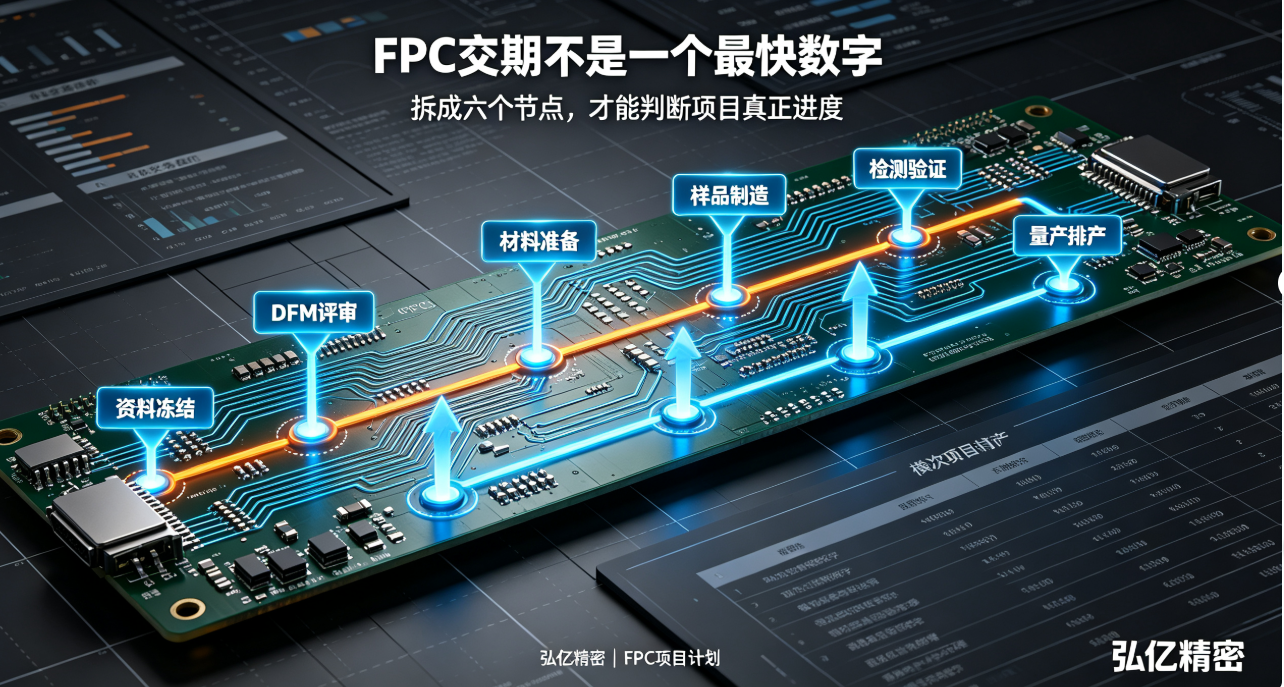
FPC project lead times cannot be assessed solely based on a manufacturer’s promise of ‘sample delivery in X days.’ This article outlines six critical nodes—design freeze, DFM review, material procurement, process execution, testing & validation, and mass production scheduling—to help buyers determine whether a proposed timeline is realistic and executable.
Key conclusion first:When an FPC manufacturer states, 'We can deliver samples in a few days,' that does not mean the project will enter mass production within those same few days. A realistic lead time must be broken down into six distinct nodes: design confirmation, engineering review, material preparation, sample manufacturing, testing & validation, and mass production scheduling—each with its own prerequisites.
If a customer submits multiple Gerber versions, an unconfirmed BOM, and ambiguous order quantities simultaneously, scheduling lacks a reliable starting point from day one. To assess feasibility, the buyer must clarify with the manufacturer the exact date from which the timeline begins—and precisely what constitutes 'delivery': bare FPC, FPCA samples, or verified low-volume production units.
1. Design freeze marks the true start of the lead time
Formal scheduling typically begins only after key documentation has been frozen. This includes Gerber files, 2D outline drawings, stack-up specifications, connector details, BOM, 3D assembly drawings, bend/flex requirements, electrical specifications, and acceptance criteria—all requiring version control and clear identification of pending items.
When documentation remains incomplete, manufacturers may provide preliminary estimates—but such estimates must not be treated as firm commitments. Changes in document versions, quantities, or added acceptance criteria can re-impact material sourcing, process planning, and test scheduling.
2. DFM review directly influences downstream scheduling
During DFM, the FPC manufacturer verifies line width/spacing, hole placement, coverlay openings, stiffener boundaries, end thickness, dimensional tolerances, and assembly clearance. For automotive and robotics applications, additional parameters—including bend trajectory, mounting points, temperature, and vibration conditions—are incorporated into the review.
Early identification of design adjustments may add one or several days to the schedule—but this is typically far more efficient than post-sample rework. Buyers should require the manufacturer to document DFM issues, ownership of revisions, and target closure dates within the master plan.
3. Materials and components often represent the overlooked critical path
Standard PI, copper foil, coverlay, and stiffeners with available inventory enable smoother scheduling; however, specified brands, non-standard thicknesses, special surface finishes, or customer-approved materials extend procurement and qualification timelines.
For FPCA assemblies incorporating SMT, connectors, or other components, long-lead-time items in the BOM may dictate the overall project schedule. During quotation, clarify whether components are customer-supplied or manufacturer-sourced—and confirm the approved substitution boundary for alternate parts.
4. Manufacturing cycle time extends beyond circuit patterning
From circuit formation to final delivery, FPC production typically includes coverlay lamination, hot press bonding, surface finishing, stiffener attachment, profile routing, electrical testing, visual inspection, and packaging. Higher layer counts, irregular branching, fine-pitch traces, and complex connector-end structures increase process verification steps.
FPCA adds further steps: stencil fabrication, fixture setup, component placement, soldering, and post-assembly functional testing. Quotations or schedules listing only 'X days of production'—without specifying the full process flow—leave buyers unable to verify whether critical steps have been omitted.
5. Validation timelines must be separated from sample delivery
After sample shipment, projects often require dimensional, electrical, mechanical fit, thermal cycling, vibration, damp heat, flex durability, or connector reliability testing. Test conditions, sample sizes, and duration vary significantly—no single fixed number applies universally.
If test failures occur, root cause analysis, corrective action, resampling, and revalidation must follow. These closed-loop milestones should be explicitly scheduled—not conflated with initial sample sign-off as project completion.
6. Mass production scheduling depends on approval status and capacity availability
Low-volume and mass production require confirmation that sample-level processes, materials, inspection methods, and assembly procedures are repeatable and scalable. Once ramped, actual shipment timing is affected by line readiness, material arrival, panelization, yield performance, packaging, and batch release logistics.
An FPC manufacturer’s quoted mass production lead time must specify the assumed monthly volume, material status, production window, and scope of inspection. Rush orders may shift schedules—but quality approvals must never be compromised by compressing validation.
Buyers are advised to request a node-based timeline table during RFQ:
Design confirmation and DFM completion date;
Material and component receipt date;
First-article, sample manufacturing, and testing dates;
Assembly, reliability validation, and issue closure dates;
Low-volume review and mass production scheduling dates;
Input, output, and responsible party for each node.
Dongguan Hongyi Precision Circuit Co., Ltd. serves automotive electronics, humanoid robotics, and consumer electronics markets with FPC and FPCA support spanning drawing evaluation, engineering prototyping, reliability validation, pilot runs, and full-scale delivery. Actual lead times depend on customer-provided data, material status, process route, order quantity, and validation scope.
For reference on prototyping documentation, seeElectronic Shifter FPC Manufacturer Quotation & RFQ Checklist; for supplier mass production capability evidence, refer toFPC Manufacturer Mass Production Capability Assessment.
Summary:A reliable FPC lead time is not a standalone 'fastest possible number'—it is a project plan that transparently maps design, material, process, testing, and approval milestones.