
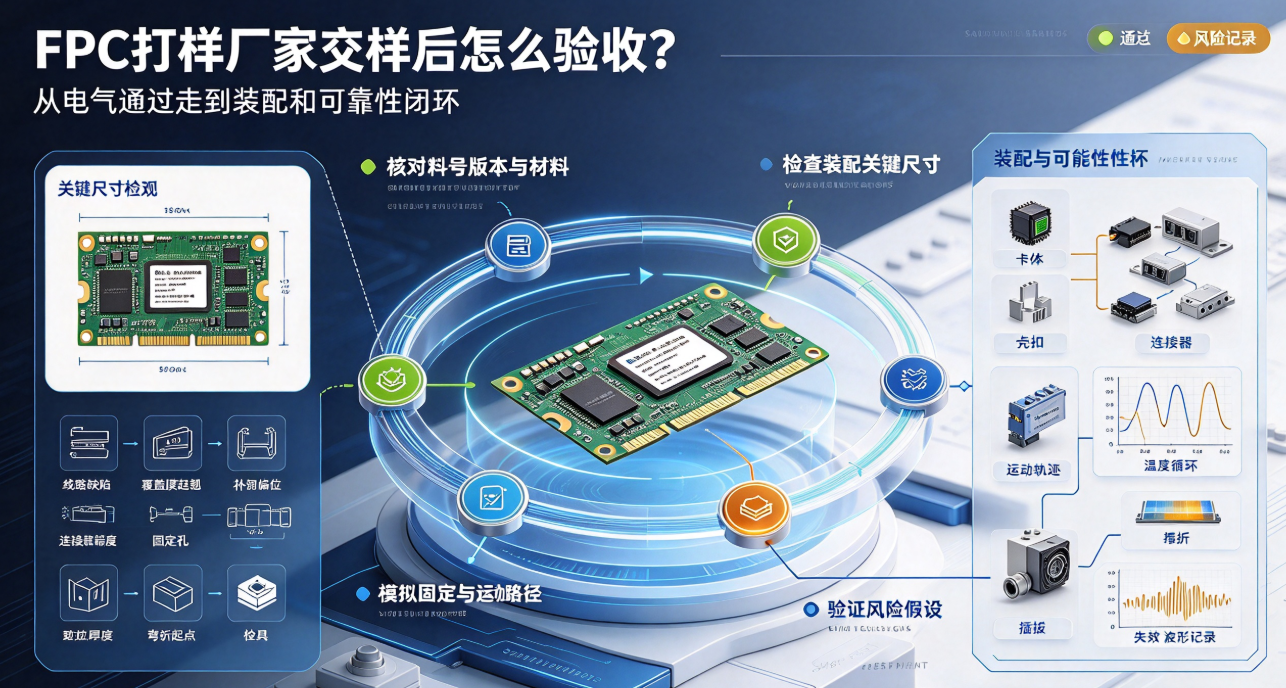
Accepting FPC prototypes based solely on continuity and visual inspection often fails to uncover bending, assembly, soldering, and material issues. This article outlines a practical, five-step acceptance methodology—receipt verification, static testing, assembly validation, dynamic validation, and issue closure.
After engaging an FPC prototype manufacturer, a common misconception is: 'If the traces conduct and the appearance looks fine, the prototype can be accepted.' The true value of the prototype stage lies not in proving that the FPC lights up or conducts, but in identifying early conflicts among design, materials, manufacturing, and assembly—thereby providing reliable inputs for the next revision and mass production.
Step 1: Confirm prototype identity before acceptance
Upon receipt, verify part number, drawing revision, BOM, stack-up, material grade, copper thickness, surface finish, quantity, and production date. For multi-round prototyping, ensure sample labels match test reports to avoid misusing legacy samples as validation results for new revisions.
If the manufacturer used interim materials, substitute stiffeners, or non-production processes to meet delivery deadlines, these deviations must be explicitly noted in the acceptance record. Without clear material and process identification, subsequent reliability data cannot be reliably reused.
Step 2: Visual and dimensional inspection must focus on assembly risks
Standard checks include trace defects, scratches, creases, contamination, coverlay lifting, stiffener misalignment, burrs, and pad condition. Critical dimensions should emphasize connector-end thickness, contact point location, mounting holes, bend initiation points, branch length, and component height.
Flexible PCBs must not be forcibly straightened for measurement outside their specified configuration per drawings. For samples requiring forming, conformal bonding, or housing insertion, use gauges or actual mechanical structures to assess interference, tension, compression damage, and snap-fit engagement.
Step 3: Electrical testing must align with functional requirements
Bare FPCs may undergo open/short, insulation resistance, impedance, or continuity testing; FPCAs require additional verification of solder joints, component polarity, functional signals, and essential programming tests. Test points and pass/fail thresholds must be defined prior to prototyping—not determined ad hoc after sample return.
Step 4: Install prototypes into real or equivalent mechanical assemblies
Assembly validation must replicate final mounting points, connectors, screws, snap-fits, bend paths, and adjacent components. For electronic shifters and robotic joints, observe friction, torsion, and connector off-axis loading during motion; for automotive lighting modules, verify conformal fit, segmented alignment, and thermal source clearance.
If a prototype passes in flat-state testing but exhibits intermittent opens or localized lifting after assembly, preserve the failure posture, capture photos and oscilloscope waveforms, document evidence first, then disassemble—avoiding disturbance of the failure state during disassembly.
Step 5: Reliability validation must directly inform design decisions
Temperature cycling, bending, vibration, mating/unmating, reflow simulation, or aging tests should not be performed merely to 'check a box.' Each test must address a specific risk hypothesis—for example: Does the coverlay delaminate across temperature extremes? Do dynamic zones fracture under repeated flexing? Do solder joints fail due to thermomechanical stress?
How to close acceptance issues
Categorize issues into five root-cause types: design, material, process, test, and assembly;
Define temporary containment actions, assign owners, specify next-revision modifications, and confirm verification methods;
Determine whether legacy samples, work-in-process, or new revisions require quarantine;
Demonstrate issue resolution via retest or second-round samples;
Embed conclusions into mass production control plans and incoming acceptance standards.
Hongyi Precision provides FPC engineering prototyping, prototype acceptance support, and FPCA validation services. Only by elevating acceptance from 'goods receipt inspection' to 'design closed-loop feedback' can customers shorten iterative revision cycles—and ensure prototypes truly serve mass production.