
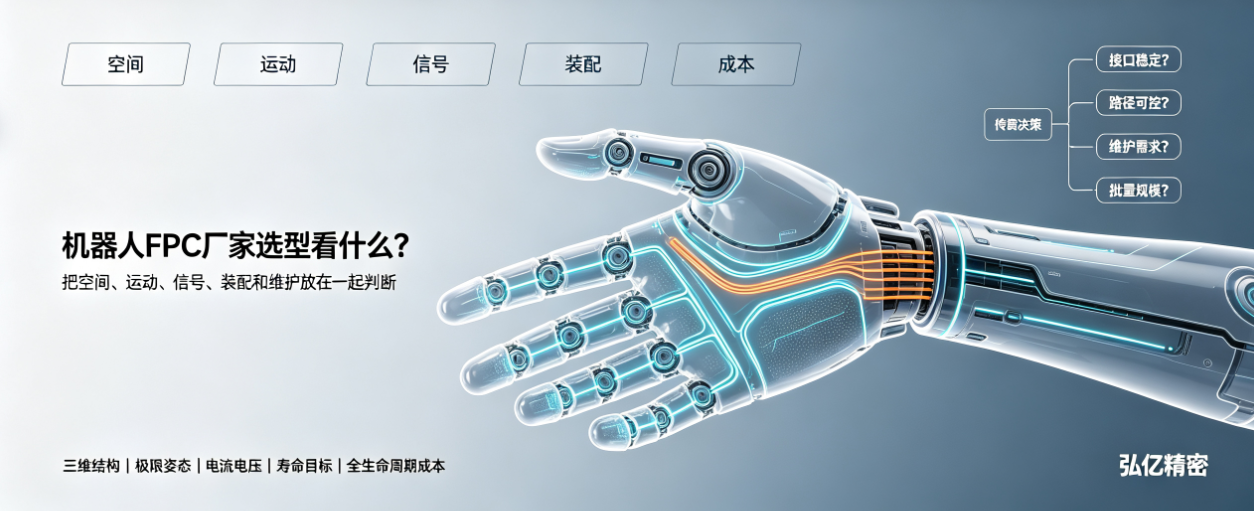
Not all connections in humanoid robots are suitable for FPC replacement of wiring harnesses. This article outlines the application boundaries of FPC, traditional wiring harnesses, and hybrid connection solutions across five dimensions: space constraints, motion requirements, signal integrity, assembly/maintenance, and mass-production cost.
Direct answer:Not all internal wiring harnesses in humanoid robots should be replaced with FPC. FPC is best suited for space-constrained, fixed-interface areas requiring high-density routing and repeatable assembly; traditional wiring harnesses retain advantages for long-stroke, multi-directional free-motion, field-serviceable, or high-current connections. Real-world projects commonly adopt a combination of FPC, connectors, and wiring harnesses—not an either/or choice.
When involved early in component selection, robotics FPC manufacturers such as Hongyi Precision must jointly evaluate 3D spatial layout, motion trajectory, signal/current requirements, assembly sequence, lifetime targets, and maintenance methodology. Comparing only for 'thinner profile' or 'higher bend endurance' risks overlooking system-level constraints.
Dimension 1: Available Space and Interface Density
Space is highly constrained around dexterous hands, fingers, wrists, vision modules, and compact sensors. Individual wires, terminals, and cable ties in traditional harnesses can occupy significant volume. FPC integrates multiple traces, pads, and branches into a controlled form factor, reducing cluttered routing.
However, once an FPC form factor is finalized, it becomes more sensitive to connector placement, sensor positioning, and assembly tolerances. If connectors, sensors, or mounting points remain subject to frequent iteration, premature finalization may increase revision costs. Interface stability should be confirmed early in prototype development.
Dimension 2: Motion Type—Controlled Bending vs. Free Oscillation
FPC performs best where motion paths are well-defined and bending direction/radius is controllable. For joints or fingers with clearly defined pivot points, travel range, and end-posture limits, robotics FPC manufacturers can design dynamic zones, trace orientation, and reinforcement transitions accordingly.
If connections require large-scale 3D free oscillation, frequent torsion, or ad-hoc path changes, traditional wiring harnesses may better absorb complex displacement. FPC can accommodate compound motion—but only with structural guidance and dedicated validation; unguided flapping inside enclosures must be avoided.
Dimension 3: Signal Integrity, Current-Carrying Capacity, and Thermal Environment
Multi-channel signals—including tactile feedback, position sensing, encoders, and vision data—are well-suited for high-density FPC interconnection. However, high-speed signals demand careful attention to impedance control, return-path continuity, crosstalk, and shielding. Motor drive and power-return circuits require evaluation of current rating, copper thickness, temperature rise, and voltage drop.
Traditional wiring harnesses offer greater flexibility for higher-current, longer-distance, or individually shielded connections. Thin FPC profile must not override current-carrying and thermal dissipation limitations. Proximity to motors and drivers also necessitates assessment of ambient temperature and electromagnetic interference (EMI).
Dimension 4: Assembly Efficiency, Serviceability, and Replacement Methodology
FPC improves repeatability in high-volume assembly through controlled geometry, alignment holes, and standardized connectors—reducing wire sorting, bundling, and manual routing effort. This integration benefit is especially pronounced for standardized modular assemblies in mass production.
However, if field-level single-wire repair, interface swapping, or on-the-fly length adjustment is required, traditional wiring harnesses offer greater flexibility. Localized FPC damage typically requires full-component replacement. Therefore, manufacturing assembly and after-sales service requirements must be jointly considered during selection.
Dimension 5: Total Cost of Ownership
During low-volume prototyping with unfrozen mechanical designs, traditional wiring harnesses often incur lower upfront modification costs. FPC requires finalized stack-up drawings, tooling, and validation—so initial unit cost cannot be compared solely against raw material cost of a few wires.
In stable high-volume production, FPC may reduce system-level cost and improve consistency by minimizing connection points, assembly labor, wiring errors, and spatial footprint. Final evaluation must include development, materials, manufacturing, assembly, testing, rework, and failure costs—not just per-unit procurement price.
Locations Warranting Priority FPC Evaluation:
Tactile and multi-sensor branching connections in dexterous hands;
Palm- and wrist-mounted modules with dense interfaces and controlled form factors;
Joint-mounted sensing and encoder connections with definable motion paths;
Vision modules, cameras, and compact display interconnections;
Coreless motor, micro-actuator, and localized sensor interconnections.
Situations Favoring Retention of Wiring Harnesses or Hybrid Solutions:
Long-stroke free-motion, higher-current applications, frequent field servicing, unfinalized interface locations, or need for rapid individual connection replacement—all support retaining traditional wiring harnesses. In complex robots, FPC may handle high-density intra-module interconnects while wiring harnesses manage inter-module long-stroke, power, and serviceable connections.
The key to successful hybrid architecture lies in predefining interface specifications between FPC and harness—including connector types, mounting methods, and motion boundary limits—to prevent mutual stress at transition zones.
Information to Provide Robotics FPC Manufacturers Prior to Selection:
3D mechanical layout, interface coordinates, assembly sequence, and extreme posture definitions;
Motion direction, stroke, frequency, bend radius, and target lifetime;
Signal type, current/voltage ratings, impedance requirements, and shielding needs;
Thermal environment, heat dissipation constraints, proximity to motors/EMI sources;
Prototype quantity, forecasted production volume, and service/replace methodology;
Electrical, dynamic, environmental, and system-level acceptance criteria.
For further reference on tight-space routing techniques, see:Routing Guidelines for Robotics FPC in Joints and Dexterous Hands; for comprehensive application context, refer to:Hongyi Precision’s FPC Manufacturer Capabilities and Humanoid Robot Solutions.
Hongyi Precision provides structural evaluation, rapid prototyping, dynamic validation, and volume production support for FPC and FPCA targeting humanoid robots, dexterous hands, joints, vision modules, and motor modules. Specific interconnect solutions must be confirmed based on overall system constraints—including space, motion, signal, serviceability, and cost objectives.
Summary:FPC and traditional wiring harnesses have no absolute superiority. FPC delivers clear integration advantages where space is limited, interfaces are dense, and motion is predictable. Conversely, wiring harnesses—or hybrid approaches—better serve applications involving free motion, high current, or demanding service requirements. Defining system boundaries first ensures interconnect selection supports functional goals—not substitution for its own sake.