
News
Industry developments and technical notes
We follow technical and market developments in automotive FPC and flexible circuits for humanoid robotics, and we welcome the conversation.
Focus areas
FPC replacing automotive harnesses
With light weight, high flex endurance and dense integration, FPC is replacing conventional harnesses across smart cockpits and body control.
Flexible circuits for humanoid robots
A single humanoid robot uses 40-70 flexible circuits, with demand growing quickly for joint drives, tactile dexterous hands and vision modules.
Automotive process and quality
We keep refining our process window and full-flow validation around demanding temperature, flex life and conductive stability criteria.
Company news
 Technical Insight
What to Confirm Before Customizing Ultra-Thin PCBs: Design, Material, and Processing Boundaries for 0.15 mm Thickness
When customers request custom ultra-thin PCBs at 0.15 mm or 0.2 mm, the most frequently overlooked factor is the interplay among layer count, hole diameter, cop…
Read more Industry insight
How to Tell Whether an FPC Manufacturer Can Handle Mass Production: Seven Signals
A website portfolio and a good prototype show only part of an FPC manufacturer’s capability. Stable delivery depends on engineering review, process windows, yie…
Read more Technical Insight
How Do Automotive Starry-Sky Roof FPCs Balance Large Dimensions with Assemblability? From Splicing Reference Points to Power Supply Zoning
Automotive starry-sky roof FPCs feature large surface areas and high LED point counts, often requiring segmented splicing per vehicle model. Stable assembly dep…
Read more Technical Insights
How to Select FPC for AI Robots: A Decision Framework from Motion Profiles and Signal Speed to Mass Production Validation
For AI robot projects, selecting FPC is not about whether traces can be electrically connected—it’s about simultaneously meeting dynamic flexing, high-speed sig…
Read more Industry Insights
How to Conduct Reliability Validation for Automotive Electronic FPCs: Correlating Lab Tests with Real Vehicle Operating Conditions
Reliability validation of automotive electronic FPCs cannot rely solely on a single pass in the lab. Temperature cycling, vibration, bending, damp heat, and pos…
Read more Technical note
How to Analyze Dexterous-Hand FPC Failures: Five Common Problems and Improvements
When a dexterous-hand FPC develops open circuits, noise, sensor drift, or assembly problems, the cause is rarely a single process. This article analyzes common…
Read more Technical Insights
Why Are LED Positions on Automotive Starry-Sky Roof FPCs Uneven? A Dual-End Diagnostic Approach—Electrical and Assembly Perspectives
When localized dark spots, brightness inconsistencies, or visible seam boundaries appear on an automotive starry-sky roof FPC, root causes may simultaneously st…
Read more Technical Insight
How Can Ultra-Thin PCBs Pass Reflow Soldering? Stack-up and Planarity Control for 0.15 mm Boards
When ultra-thin PCBs enter SMT, warpage during reflow soldering, solder paste printing stability, and component placement accuracy become new challenges. A 0.15…
Read more Industry Insights
Why FPC Manufacturer Quotes Vary Widely: A Breakdown of Material, Yield, and Delivery Costs
The same FPC drawing can yield significantly different quotes from different manufacturers. Price differences don’t necessarily indicate who is cheaper—or who i…
Read more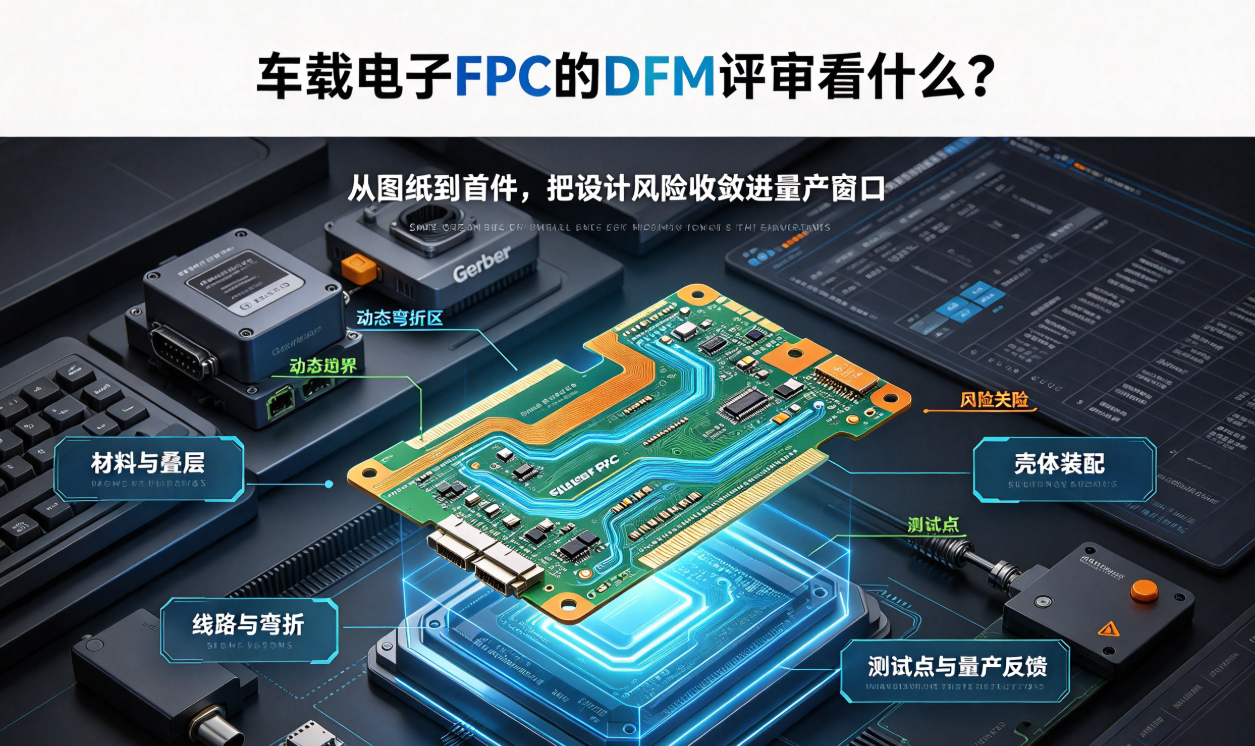 Industry Insights
What to Review in DFM for Automotive FPCs: A Risk Checklist from Drawing to First Article
The most valuable step before mass production of automotive FPCs is DFM review. Proactively verifying materials, stack-up, trace width/spacing, flex zones, pads…
Read more